
Overview
The moment you step off the cable car at Zhangjiajie National Forest Park and see those impossible sandstone pillars rising through the mist, you'll understand why James Cameron came here seeking inspiration. These are the mountains that became Pandora's floating Hallelujah Mountains in Avatar—and in person, they're even more surreal than anything CGI could create.
Zhangjiajie (张家界) was China's first national forest park, established in 1982, and the heart of the larger Wulingyuan Scenic Area that earned UNESCO World Heritage status in 1992. Over 3,000 quartzite sandstone pillars—some reaching 200 meters into the sky—rise from subtropical forest like the bones of an ancient world. Formed over 380 million years through uplift and erosion, these formations create a landscape unlike anywhere else on Earth.
But Zhangjiajie is more than a photo backdrop. It's a vast wilderness covering 4,810 hectares with multiple scenic zones, each offering different perspectives on this geological wonder. You could spend three days here and still not see everything—or you could hit the highlights in one packed day if that's all you have.
This guide covers everything: how to plan your visit, which zones to prioritize, how to catch the famous sea of clouds, current 2026 ticket prices, and the best ways to get here from major Chinese cities.
Quick Facts at a Glance
| Item | Details |
|---|---|
| Location | Zhangjiajie City, Hunan Province (northwestern Hunan) |
| Opening Hours | Peak (Apr 1–Nov 30): 07:00–18:00 · Off-peak (Dec 1–Mar 31): 07:30–17:30 |
| Entrance Fee | ¥228 combo ticket (4-day pass + shuttle buses) or ¥165 entrance only |
| Best Time to Visit | Spring (Apr–May) and Autumn (Sep–Nov) for best weather and visibility |
| Sea of Clouds | Summer mornings after rain; best at Tianzi Mountain and Yuanjiajie |
| Elevation | 1,000–1,300 meters average, peaks up to 1,518 meters |
| UNESCO Status | World Heritage Site since 1992 (Wulingyuan Scenic Area) |
| Getting There | Fly to Zhangjiajie Hehua Airport (DYG), then 40 min by bus/taxi |
| Recommended Duration | 2–3 full days minimum |
The Main Scenic Zones: Where to Go and What to See
Zhangjiajie National Forest Park contains several distinct scenic zones, each with its own character. Understanding them before you go will save hours of confusion and help you prioritize based on your time and interests.
Yuanjiajie Scenic Area — The Avatar Mountains
This is what most people come for. Yuanjiajie (袁家界) is home to the most iconic pillar formations, including the one that inspired the Hallelujah Mountains in Avatar. The pillar was officially renamed "Avatar Hallelujah Mountain" (哈利路亚山) in 2010.
Must-See Spots:
- Avatar Hallelujah Mountain (哈利路亚山) — The 1,074-meter pillar that started it all. A steel viewing platform lets you photograph it from multiple angles.
- Back Garden (后花园) — A natural rock garden with dozens of pillars creating an intimate, enclosed landscape. One of the best spots for sea of clouds photography.
- First Natural Bridge Under Heaven (天下第一桥) — A natural stone arch spanning two peaks at 357 meters above the valley floor.
- Labyrinth (迷魂台) — A viewing platform overlooking an ocean of pillars disappearing into the clouds.
| For | First-time visitors, Avatar fans, photographers |
| Difficulty | Easy (accessible via Bailong Elevator + shuttle + flat walkways) |
| Time Needed | 2–3 hours |
| Crowds | High—this is the most popular zone |
Pro tip: Arrive before 8:00 AM or after 3:00 PM to avoid the worst crowds. The morning mist often makes for better photos anyway.
Tianzi Mountain Nature Reserve — The Sea of Peaks
Tianzi Mountain (天子山) sits at the northwestern edge of the park and offers the most expansive views. Where Yuanjiajie feels intimate—pillars rising close around you—Tianzi feels epic, with over 2,000 peaks visible from certain viewpoints. This is the #1 spot for sea of clouds photography.
Must-See Spots:
- Helong Park (贺龙公园) — Named after the revolutionary general born nearby, featuring a bronze statue and excellent panoramic views.
- West Sea Stone Forest (西海石林) — Thousands of peaks stretching to the horizon, best viewed at sunset. When clouds fill the valley, this becomes an ocean of white.
- Imperial Writing Brush Peak (御笔峰) — A cluster of thin pillars resembling calligraphy brushes.
- Fairy Maiden Scattering Flowers (仙女散花) — A graceful pillar formation with legend attached.
| For | Panoramic views, sunset photography, sea of clouds hunters |
| Difficulty | Easy (cable car access + flat walking paths) |
| Time Needed | 2–3 hours |
| Crowds | Moderate to high |
Golden Whip Stream — Forest Floor Walking
For a completely different experience, descend to the valley floor and walk the 7.5-kilometer Golden Whip Stream (金鞭溪). This shaded forest trail follows a crystal-clear stream past moss-covered rocks, wild monkeys, and dramatic pillar views from below.
Highlights:
- Golden Whip Rock (金鞭岩) — A 350-meter pillar resembling a golden whip.
- Reunion Rock (劈山救母) — A pillar split in half, associated with the legend of a son splitting a mountain to save his mother.
- Purple Grass Pond (紫草潭) — A quiet pool perfect for reflection photos.
| For | Nature lovers, hikers, escape from crowds |
| Difficulty | Easy (flat path, 2–3 hours one-way) |
| Time Needed | 3–4 hours for full walk |
| Crowds | Low to moderate |
Best time: Morning, when mist lingers in the valley and macaques are most active. This is a perfect foggy-day alternative when mountain-top visibility is poor.
Yangjiajie Scenic Area — The New Frontier
Yangjiajie (杨家界) opened more recently and remains less crowded than Yuanjiajie or Tianzi. The landscape is similar—dramatic pillar formations—but you'll have more peace to enjoy it.
Highlights:
- Wulong Village (乌龙寨) — A former bandit stronghold requiring a challenging hike through narrow passages.
- Natural Great Wall (天然长城) — A ridge of peaks resembling the Great Wall viewed from above.
- One Step to Heaven (一步登天) — A vertigo-inducing ladder to a 400-meter viewpoint.
| For | Adventure seekers, crowd avoiders |
| Difficulty | Moderate to challenging (steep stairs, narrow passages) |
| Time Needed | 3–4 hours |
| Crowds | Low |
Getting Up and Down: Elevators, Cable Cars & Trails
Zhangjiajie's mountain zones sit 1,000+ meters above the entrance gates. You have four main options for ascending, each with different trade-offs in cost, time, and experience.
Bailong Elevator (百龙天梯) — The Fast Way Up
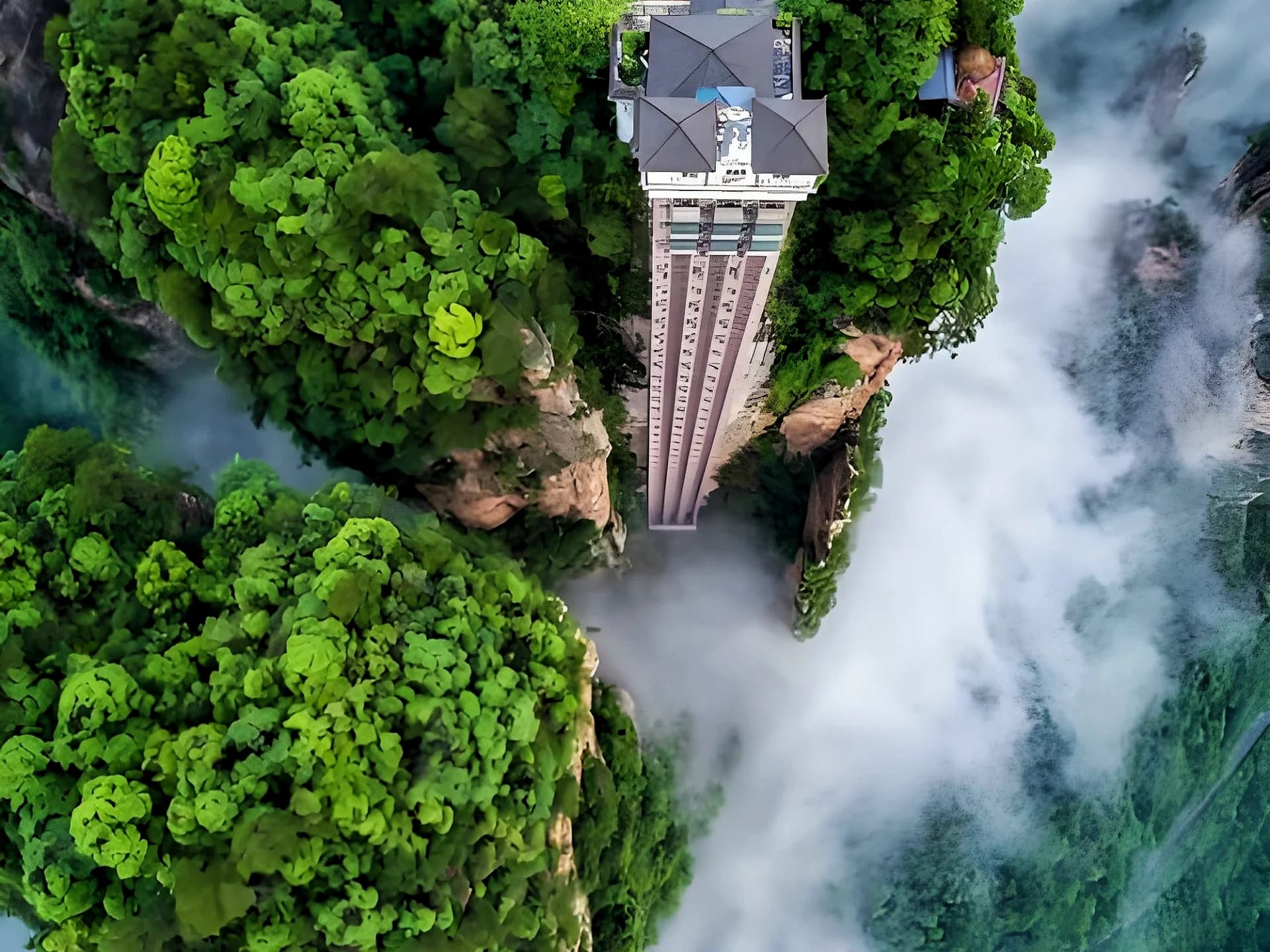
The world's tallest outdoor elevator rises 326 meters in just 66 seconds, carrying you from the valley floor to Yuanjiajie. It's an engineering marvel and the quickest way to the Avatar Mountains.
| Detail | Info |
|---|---|
| Height | 326 meters (1,070 feet) |
| Ride time | 66 seconds |
| Capacity | 50 passengers per car, 3 cars running |
| Price | ¥65 up, ¥65 down (one-way each) |
| Hours | Same as park hours |
| Queue time | 10–20 min (off-peak), 40–90 min (peak season/weekends) |
Pros: Fast, dramatic views through glass walls, connects directly to Yuanjiajie. Cons: Expensive, often crowded, some find the height unsettling.
Tianzi Mountain Cable Car — The Scenic Descent
Most visitors take Bailong Elevator up and Tianzi Mountain Cable Car down (or vice versa). The cable car offers 6 minutes of spectacular aerial views across the pillar forest.
| Detail | Info |
|---|---|
| Length | 2,084 meters |
| Ride time | 6 minutes |
| Price | ¥72 one-way |
| Queue time | Usually shorter than Bailong |
Yangjiajie Cable Car
A newer cable car serving the Yangjiajie scenic area directly.
| Detail | Info |
|---|---|
| Price | ¥76 one-way |
| Best for | Direct access to Yangjiajie, avoiding Bailong crowds |
Huangshi Village Cable Car
An older, smaller cable car serving Huangshi Village scenic area. Less crowded than the main two.
| Detail | Info |
|---|---|
| Price | ¥65 one-way |
| Best for | Accessing Huangshi Village specifically |
Hiking (Free but Exhausting)
You can walk up or down instead of using elevators/cable cars. The main hiking route from Golden Whip Stream to Yuanjiajie via "Random Walk" (乱窜坡) is roughly 8,000 steep stairs.
| Time | 2–3 hours up, 1.5–2 hours down |
| Difficulty | Challenging |
| Best for | Budget travelers, fitness enthusiasts, crowd avoiders |
Our recommendation: Bailong up, explore Yuanjiajie and Tianzi, cable car down. Save your legs for walking the mountain tops.
Our Recommended Itineraries
How you approach Zhangjiajie depends on your time. Here are three tested itineraries covering one, two, and three days.
One-Day Express (If That's All You Have)
| Best for | Time-limited visitors |
| What you'll see | Yuanjiajie highlights only |
| Pace | Fast |
The plan:
- Enter via Forest Park Gate (武陵源门票站) by 7:30 AM
- Bailong Elevator up to Yuanjiajie (¥65)
- Walk the circuit: Avatar Mountain → Back Garden → First Natural Bridge → Labyrinth (2–3 hours)
- Shuttle bus to Tianzi Mountain, quick visit to Helong Park (1 hour)
- Tianzi Cable Car down (¥72)
- Exit via Wulingyuan Gate
What you'll miss: Golden Whip Stream, Yangjiajie, leisurely exploration.
Two-Day Classic (Recommended for Most Visitors)
Day 1 — Mountain Tops:
- Enter via Forest Park Gate, Bailong Elevator up
- Explore Yuanjiajie thoroughly (3 hours)
- Shuttle to Tianzi Mountain, explore Helong Park and West Sea (2–3 hours)
- Shuttle to Yangjiajie if time permits (2 hours)
- Tianzi Cable Car down, exit via Wulingyuan
Day 2 — Valley Floor:
- Enter via Forest Park Gate
- Walk Golden Whip Stream (3–4 hours)
- Optional: Hike up to Yuanjiajie via Random Walk, or revisit mountain zones
- Exit
Three-Day Deep Dive (The Full Experience)
Day 1 — Yuanjiajie & Tianzi: Same as Day 1 of Two-Day Classic.
Day 2 — Yangjiajie Adventure:
- Enter via Yangjiajie Gate (less crowded)
- Explore Wulong Village, Natural Great Wall, One Step to Heaven (4–5 hours)
- Shuttle to revisit favorite spots from Day 1
- Sunset at West Sea Stone Forest
Day 3 — Golden Whip Stream & Huangshi Village:
- Morning walk along Golden Whip Stream
- Ascend to Huangshi Village (cable car or hike)
- Explore Huangshi Village scenic points (2–3 hours)
- Descend and exit
Planning a trip to China?
Our travel experts can help you create a personalized itinerary based on your interests and budget.
Practical Tips: What to Wear, Bring & Know
Zhangjiajie is a real mountain wilderness, not a manicured theme park. Proper preparation will make the difference between a magical experience and a miserable one.
What to Wear
Footwear: Comfortable walking shoes with good grip. The paths are paved but can be slippery when wet (which is often). Hiking boots are ideal but not required.
Clothing by season:
- Spring/Autumn: Layers essential—mornings can be cool (10–18°C), afternoons warm (20–25°C). Light jacket recommended.
- Summer: Light, breathable clothes. Rain jacket or umbrella mandatory—sudden showers are common. Hat and sunscreen for exposed viewpoints.
- Winter: Full cold-weather gear (0–10°C). Some areas may be closed due to ice.
What to Bring
| Must-Have | Nice to Have |
|---|---|
| Water (1.5L+ per day) | Snacks/energy bars |
| Rain jacket or umbrella | Hiking poles |
| Sunscreen + hat | Power bank |
| Comfortable daypack | Binoculars |
| Cash (some vendors don't take cards) | Change of socks |
Food inside the park: Basic restaurants at major hubs (Yuanjiajie, Tianzi, etc.) serving simple Chinese meals for ¥30–60. Quality is mediocre—bring snacks.
Weather Considerations
| Season | Temperature | Conditions | Notes |
|---|---|---|---|
| Spring (Mar–May) | 12–22°C | Frequent rain, lush green | Waterfalls at their best |
| Summer (Jun–Aug) | 22–32°C | Hot, humid, thunderstorms | Best for sea of clouds |
| Autumn (Sep–Nov) | 10–22°C | Clear skies, dry | Best visibility, peak crowds |
| Winter (Dec–Feb) | 2–10°C | Cold, occasional snow | Fewest crowds, some closures |
How to Get to Zhangjiajie
Zhangjiajie has its own airport and train station, making it accessible from all major Chinese cities. Here are all your options.
By Air
Zhangjiajie Hehua International Airport (DYG) has direct flights from:
- Beijing (2.5 hours)
- Shanghai (2 hours)
- Guangzhou (1.5 hours)
- Chengdu (1.5 hours)
- Xi'an (1.5 hours)
- Changsha (45 minutes)
From airport to park:
- Taxi: ¥100–150, 40 minutes to Wulingyuan (park entrance area)
- Airport bus: ¥20, runs to Zhangjiajie City center, then transfer
By Train
Zhangjiajie Railway Station (普通火车) and Zhangjiajie West High-Speed Station (张家界西) connect to:
- Changsha: 4–5 hours (regular), 2 hours (high-speed)
- Guangzhou: 7–8 hours (high-speed via Changsha)
- Shanghai: 8–10 hours (high-speed)
From stations to park:
- Bus from Zhangjiajie Central Bus Station to Wulingyuan: ¥12–15, 1 hour
- Taxi to Wulingyuan: ¥100–120, 40 minutes
By Bus
Long-distance buses connect Zhangjiajie to Changsha (4 hours), Fenghuang Ancient Town (4 hours), and other regional destinations.
Getting Around the Park
Free shuttle buses operate between all major zones once you're inside the park. Routes connect:
- Forest Park Gate ↔ Golden Whip Stream ↔ Bailong Elevator
- Bailong Elevator ↔ Yuanjiajie ↔ Tianzi Mountain ↔ Yangjiajie
The shuttle system is efficient—just check the route maps at each station.
Tickets and Costs: Complete Breakdown
Zhangjiajie uses a unified ticket system covering multiple days and zones. Here's exactly what you'll pay with 2026 prices. For a full picture of travel costs across China, see our budget guide.
Main Entrance Ticket (2026 Prices)
Zhangjiajie uses simplified year-round rates:
| Ticket Type | Price | Validity |
|---|---|---|
| Combo Ticket (门票+环保车) | ¥228 | 4 days, includes shuttle buses |
| Entrance Only (单门票) | ¥165 | 4 days, no shuttle buses |
| Student/Child (1.2–1.5m) | ¥147 (combo) / ¥87 (entrance) | 4 days |
| Child (under 1.2m) | Free | — |
| Senior (65+) | Free | — |
| Annual Pass | ¥298 | 1 year, unlimited entries |
Included in combo ticket: Access to all scenic zones within Zhangjiajie National Forest Park + free shuttle buses.
Not included: Bailong Elevator, cable cars, Tianmen Mountain (separate attraction).
Additional Costs
| Item | One-Way | Round-Trip |
|---|---|---|
| Bailong Elevator | ¥65 | ¥130 |
| Tianzi Mountain Cable Car | ¥72 | ¥144 |
| Yangjiajie Cable Car | ¥76 | ¥152 |
| Huangshi Village Cable Car | ¥65 | ¥130 |
Budget Calculator
| Scenario | Cost Per Person |
|---|---|
| Budget: Combo ticket + walk everything | ¥228 |
| Standard: Combo + Bailong up + Tianzi down | ¥365 |
| Comfortable: All transport + 2 days food | ¥450–550 |
Booking Tickets
Online (recommended):
- Official WeChat: "张家界国家森林公园"
- Trip.com, Klook, or Ctrip
At the gate: Possible but expect queues during peak season.
Peak season warning (May 1–3, Oct 1–7): Book at least 3–5 days in advance. Entry quotas may apply.
Best Time to Visit & How to See the Sea of Clouds
Zhangjiajie is beautiful year-round, but different seasons offer dramatically different experiences. Here's what to expect—and how to catch the famous sea of clouds. For a country-wide overview, see our guide to the best time to visit China.
By Season
Spring (March–May) ⭐⭐⭐⭐ Fresh green vegetation, waterfalls at peak flow, pleasant temperatures (12–22°C). Frequent rain creates dramatic mist effects but can limit visibility. Crowds are moderate.
Summer (June–August) ⭐⭐⭐⭐ BEST FOR SEA OF CLOUDS Hot and humid (22–32°C), with afternoon thunderstorms common. This is actually the best time for "sea of clouds" photography—morning fog fills valleys while pillar tops pierce through. Bring rain gear and patience.
Autumn (September–November) ⭐⭐⭐⭐⭐ BEST OVERALL Clear skies, comfortable temperatures (10–22°C), lowest humidity, best visibility for photography. Foliage adds color in late October. This is peak tourist season—book everything in advance.
Winter (December–February) ⭐⭐⭐ Cold (2–10°C), occasional snow creates magical scenery. Some trails and cable cars may close due to ice. Very few crowds. Budget accommodation rates.
How to See the Sea of Clouds (云海)
The famous "sea of clouds" is when fog fills the valleys and only the pillar tops remain visible—creating the illusion of islands floating in a white ocean. Here's how to maximize your chances:
Best Conditions:
- Timing: Early morning, 6:00–8:00 AM
- Weather: The day after rain, when skies clear. Check forecast for "雨后转晴"
- Season: Summer has highest probability; September–October averages 20 cloud-sea days per month
- Worst time: Winter (very low probability), midday (clouds dissipate)
Best Viewing Spots:
| Location | Why It's Good |
|---|---|
| Tianzi Mountain (West Sea) | Widest panorama, 2000+ peaks visible |
| Yuanjiajie (Back Garden) | Intimate views, pillars rise through clouds |
| Yangjiajie | Fewer crowds, equally dramatic |
Strategy: If you wake up to fog, don't despair—head to the mountain tops immediately. What looks like bad weather at ground level often means sea of clouds above. The effect typically lasts 2–3 hours after sunrise before burning off.
By Day of Week
| Crowd Level | |
|---|---|
| Monday–Friday | Moderate (Chinese tour groups still present) |
| Saturday–Sunday | High |
| Chinese holidays | Extreme—avoid if possible |
Zhangjiajie National Forest Park vs Tianmen Mountain: Which Should You Visit?
Visitors often confuse these two attractions or wonder which to prioritize. They're completely different experiences—here's how to choose.
"Zhangjiajie" refers to multiple attractions, but the two biggest are Zhangjiajie National Forest Park (this guide) and Tianmen Mountain. They require separate tickets and serve different interests.
Side-by-Side Comparison
| Aspect | Zhangjiajie National Forest Park | Tianmen Mountain |
|---|---|---|
| What You'll See | 3,000+ sandstone pillars, Avatar Mountains, valleys, streams | Glass skywalk, Tianmen Cave, world's longest cable car |
| The Experience | Immersive nature, hiking, photography | Thrill-seeking, dramatic views, engineering marvels |
| Time Needed | 2–3 days minimum | 4–6 hours (1 day) |
| Ticket Price | ¥228 (combo) | ¥278–318 (includes cable car) |
| Location | Wulingyuan, 40 min from city | City center, next to train station |
| Physical Demand | Moderate (15,000–25,000 steps/day) | Low-moderate (escalators available) |
| Best For | Nature lovers, photographers, hikers | Thrill-seekers, short trips, glass walk fans |
| UNESCO Status | ✅ World Heritage Site | ❌ |
| Sea of Clouds | Excellent (multiple viewpoints) | Good (single viewpoint) |
When to Choose the Forest Park
- You have 2+ days in Zhangjiajie
- You love hiking and nature photography
- You want to see the real Avatar Mountains
- You prefer natural landscapes over man-made attractions
- You want to experience the sea of clouds from multiple angles
When to Choose Tianmen Mountain
- You only have 1 day in Zhangjiajie
- You specifically want the glass skywalk experience
- You're arriving/departing by train (it's next to the station)
- You prefer dramatic engineering over pure nature
- Heights and thrills excite rather than terrify you
Our Recommendation
If you have 3+ days: Do both. Spend 2 days in the Forest Park, 1 day at Tianmen Mountain.
If you have 2 days: Forest Park only—it's the main attraction and needs the time.
If you have 1 day: Tough choice. Forest Park gives you the iconic Avatar scenery but feels rushed. Tianmen Mountain is designed for single-day visits. Choose based on whether you prioritize nature (Forest Park) or thrills (Tianmen).
For the complete Tianmen Mountain experience, see our Tianmen Mountain Ultimate Guide.
Combining with Other Attractions
Most visitors combine Zhangjiajie National Forest Park with nearby attractions. Here are the best pairings.
Zhangjiajie Grand Canyon Glass Bridge
The world's highest and longest glass-bottomed bridge spans the Zhangjiajie Grand Canyon. Heart-stopping views, strict visitor quotas, requires advance booking.
Add: Half day. Located 1 hour from Wulingyuan.
For detailed planning, see our Zhangjiajie Glass Bridge Guide.
Fenghuang Ancient Town (凤凰古城)
A beautifully preserved riverside town 4 hours south of Zhangjiajie. Wooden stilt houses, ethnic Miao culture, atmospheric night scenes.
Add: 1–2 days.
Furong Town (芙蓉镇)
Smaller, less touristy waterfall town 2 hours from Zhangjiajie. Famous for rice tofu and dramatic waterfall running through the village center.
Add: Half day to 1 day.
Suggested Multi-Day Routes
5-Day Zhangjiajie Classic:
- Day 1: Arrive Zhangjiajie, Tianmen Mountain
- Day 2–3: Zhangjiajie National Forest Park
- Day 4: Glass Bridge + Furong Town
- Day 5: Fenghuang Ancient Town, depart
3-Day Highlights:
- Day 1: Tianmen Mountain (morning), transfer to Wulingyuan
- Day 2: Forest Park (Yuanjiajie + Tianzi Mountain)
- Day 3: Forest Park (Golden Whip Stream), depart
Where to Stay Near Zhangjiajie
Choosing the right base will significantly impact your park experience. Here are your main options.
Wulingyuan (武陵源) — Best for Park Access
The town adjacent to the park's main entrance. Walking distance to ticket gates, restaurants, and tour services.
Pros: Most convenient for early morning entry, wide range of accommodation. Cons: Touristy, limited nightlife.
Budget: ¥80–200/night Mid-range: ¥200–500/night Luxury: ¥500–1,500/night (several 4-star options)
Zhangjiajie City Center — Best for Transport Connections
The main urban center, 30–40 minutes from the park.
Pros: Better restaurants, closer to airport/train station, Tianmen Mountain is here. Cons: Requires daily commute to the park.
Inside the Park — For Hardcore Enthusiasts
A few basic guesthouses exist inside the park (near Tianzi Mountain and Yuanjiajie). Staying overnight lets you catch sunrise without fighting entrance queues.
Pros: Empty trails at dawn and dusk, best chance for sea of clouds. Cons: Very basic facilities, limited availability, must carry overnight bags through the park.
Common Mistakes to Avoid
Don't learn these lessons the hard way. Here are the most common visitor mistakes and how to avoid them.
1. Only Allowing One Day
Zhangjiajie is vast. One day means rushing through Yuanjiajie and missing everything else. Minimum: 2 full days.
2. Visiting Only Yuanjiajie
Yes, it has the Avatar Mountains. But Tianzi, Yangjiajie, and Golden Whip Stream offer equally stunning—and often less crowded—experiences. Spread your time.
3. Giving Up on Foggy Days
Fog at ground level often means sea of clouds at the summit. If it's foggy, go UP immediately—you might catch the most magical views of your trip. Alternatively, walk Golden Whip Stream, which is beautiful in mist.
4. Not Checking Weather
Clear conditions are needed for long-distance views. Check forecasts and adjust plans accordingly. If Day 1 is foggy, do Golden Whip Stream and save mountain tops for clearer Day 2.
5. Underestimating Walking
Even with elevators and cable cars, you'll walk 15,000–25,000 steps per day on mountain platforms. Wear proper shoes. Rest when needed.
6. Peak Holiday Visits
National Day week (October 1–7) and Labor Day (May 1–3) bring 50,000+ daily visitors. The experience is miserable—endless queues, crowded platforms, impossible photos. Avoid if at all possible.
7. Confusing Zhangjiajie Attractions
"Zhangjiajie" refers to multiple attractions:
- Zhangjiajie National Forest Park — The main pillar landscape (this guide)
- Tianmen Mountain — Separate attraction with glass walkway
- Zhangjiajie Grand Canyon — Separate attraction with glass bridge
Each requires separate tickets and planning.
History and Geology: How These Mountains Formed
Understanding how these pillars formed—and why they matter culturally—adds depth to your visit beyond simple sightseeing.
Geological Formation
The sandstone pillars of Zhangjiajie began forming over 380 million years ago during the Devonian period, when the area was an ancient seabed. Layers of quartz sandstone accumulated, then tectonic forces uplifted the region. Over millions of years, water erosion carved vertical fissures, eventually isolating individual pillars.
The distinctive quartzite composition gives the rock its remarkable hardness—these pillars erode roughly 1 mm per century, meaning they'll outlast most human structures by orders of magnitude.
Cultural Significance
Long before UNESCO designation, these mountains held spiritual significance for the Tujia people, one of China's 56 recognized ethnic groups native to this region. Tianzi Mountain is named for a Tujia leader, Xiang Dakun, who led an uprising here in the 12th century and declared himself "Tianzi" (Son of Heaven).
The region remained relatively unknown to outside visitors until the 1970s, when artist Wu Guanzhong began painting the landscape and advocating for its preservation. The forest park was established in 1982.
The Avatar Connection
When James Cameron was designing the floating Hallelujah Mountains for Avatar (2009), his team drew inspiration from Zhangjiajie's pillar formations. The resemblance is striking—especially when clouds fill the valleys and the peaks appear to float.
In 2010, one pillar was officially renamed "Avatar Hallelujah Mountain," cementing the connection. Tourist numbers increased dramatically, transforming Zhangjiajie from a domestic attraction into an international destination.
Planning Your China Trip
- How much does it cost? — Complete breakdown of daily budgets, attraction fees, and transport costs across China
- Best time to visit — Month-by-month guide to weather, crowds, and holiday periods
- Essential tips for first-timers — Apps to download, payment setup, cultural etiquette, and common mistakes
About This Guide
This guide was written by the Gopagoda Travel team based on multiple site visits, official Chinese-language sources, and current traveler reports. Prices were verified against official channels as of January 2026. Opening hours and ticket policies are subject to change—confirm with the official WeChat account "张家界国家森林公园" before visiting.
For more Zhangjiajie planning, see our Zhangjiajie destination guide.