
Overview
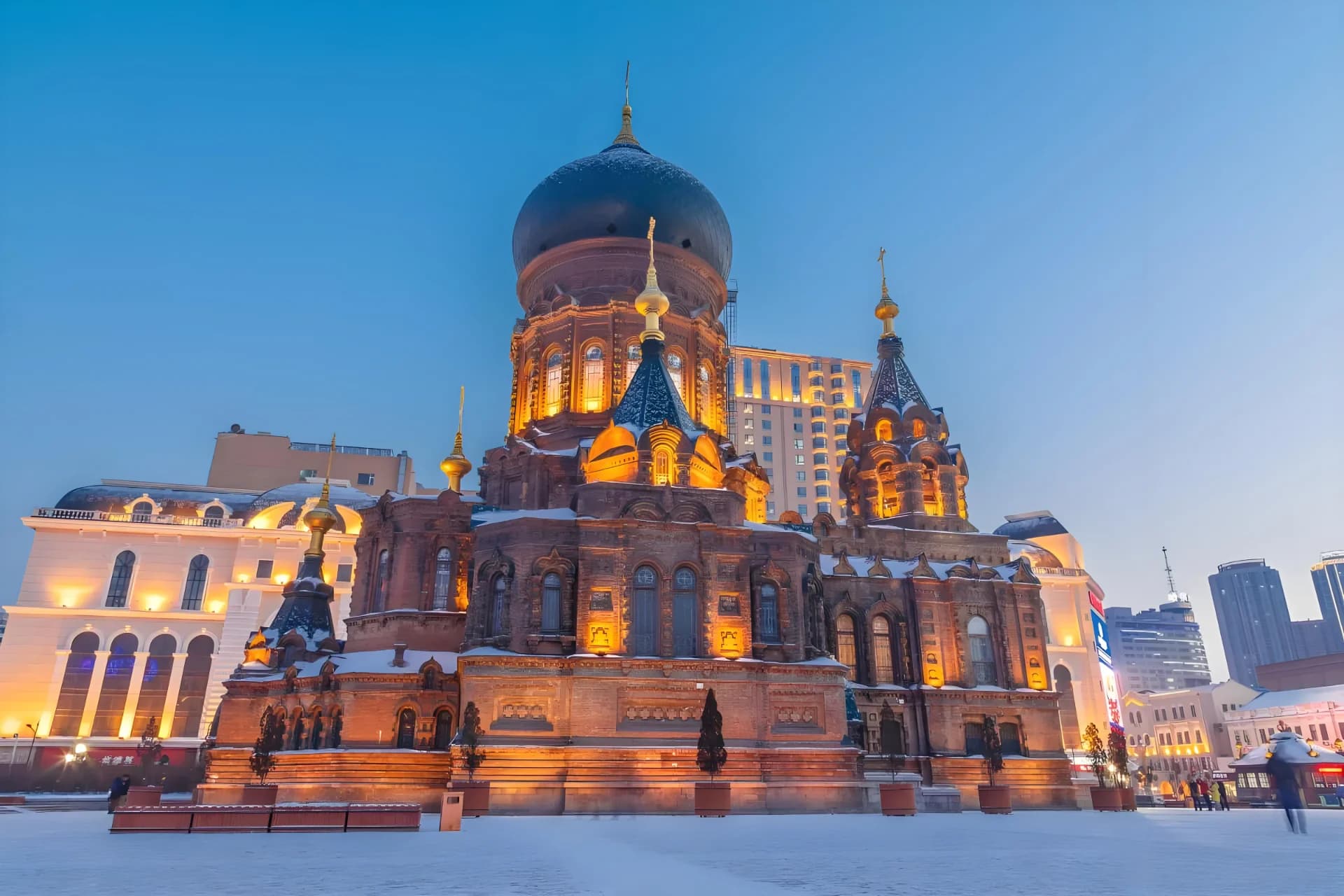
You're standing in a Chinese city, but the building before you belongs to Moscow. Green onion domes rise against the sky, topped with golden Orthodox crosses. Red brick walls frame arched windows in Byzantine style. A massive central dome soars 48 meters high. Pigeons scatter across the cobblestone square as tourists take photos in front of what looks like a portal to Imperial Russia.
This is Saint Sophia Cathedral (圣索菲亚大教堂)—Harbin's most recognizable landmark and a living monument to the city's unique history as a Russian-built railway town. Constructed between 1907 and 1932, the cathedral once served the thousands of Russian emigrants who built the Chinese Eastern Railway and made Harbin their home. Today, it stands as the largest Orthodox church in the Far East and one of China's most photogenic architectural treasures.
The cathedral no longer functions as a church—it's now the Harbin Architecture Art Museum—but its exterior remains magnificently preserved. Whether dusted with winter snow, lit dramatically at night, or framed against summer blue skies, Saint Sophia is Harbin's unmissable landmark and a perfect example of the city's "Eastern Moscow" heritage.
Quick Facts at a Glance
| Item | Details |
|---|---|
| Location | Toulong Street, Daoli District, Harbin |
| Construction | 1907–1932 |
| Architectural Style | Byzantine-Russian Orthodox Revival |
| Height | 53.35 meters (main dome 48.55 meters) |
| Museum Hours | 08:30–17:00 (varies by season) |
| Museum Entry | ¥15–20 (exterior viewing free) |
| Best Time to Visit | Morning for photos, evening for lighting |
| Time Needed | 30 min–1 hour |
The Cathedral's Story: A Russian Church in China
Understanding why a Russian Orthodox cathedral stands in northeast China reveals one of modern Asia's most fascinating historical chapters.
The Russian Railway Town
Harbin didn't exist before the Russians came. In 1898, the Russian Empire began constructing the Chinese Eastern Railway—a shortcut across Manchuria that would connect the Trans-Siberian Railway to Vladivostok. They needed a headquarters, so they built one from scratch: Harbin.
By the early 1900s, Harbin was essentially a Russian city on Chinese soil. Russian engineers, workers, merchants, and their families flooded in. At its peak, the Russian community numbered over 100,000. They built Harbin in their own image: Russian architecture, Russian shops, Russian restaurants, Russian churches.
Saint Sophia was the crown jewel. Construction began in 1907 as a wooden church for Russian railway workers. Between 1923 and 1932, it was rebuilt in the grand stone structure we see today—designed to serve not just as a parish church but as Harbin's Russian Orthodox cathedral.
After the Russians Left
The Russian community's fate changed with history. After the 1917 Revolution, White Russian refugees swelled Harbin's population. But Japanese occupation during World War II, followed by Soviet troops and then the Chinese Communist victory in 1949, gradually emptied the city of its Russian residents.
By the 1960s, almost all Russians were gone. Saint Sophia was converted to a warehouse during the Cultural Revolution. It fell into disrepair.
Restoration and Preservation
In 1997, the Harbin government restored Saint Sophia as part of a larger effort to preserve the city's architectural heritage. The interior was converted into the Harbin Architecture Art Museum, displaying photographs and models of the city's Russian-era buildings.
Today, the cathedral is a protected national heritage site and Harbin's most visited landmark—a symbol of the city's unique multicultural past.
Visiting Saint Sophia Cathedral
Here's everything you need to know about visiting the cathedral, from hours and tickets to the best times for photos.
Location and Getting There
Saint Sophia is in Harbin's Daoli District, within easy walking distance of Central Street and other major attractions.
| From | Method | Time |
|---|---|---|
| Central Street | Walk | 10–15 min |
| Harbin Train Station | Walk or taxi | 15 min walk / 5 min taxi |
| Harbin West Station | Metro + walk | 30–40 min |
| Hotel in Daoli District | Walk | Usually under 15 min |
Address: 88 Toulong Street, Daoli District (道里区透笼街88号)
Hours and Tickets
Exterior viewing: Free, any time (24/7 access to the square)
Museum interior:
| Item | Details |
|---|---|
| Hours | 08:30–17:00 (last entry 16:30) |
| Hours (winter) | May close earlier—check locally |
| Adult ticket | ¥15–20 |
| Student/senior | Discounted |
Is the museum worth it? The interior is interesting but not essential. The exterior is the main attraction—most visitors spend their time in the square taking photos.
Best Times to Visit
| Time | Experience | Notes |
|---|---|---|
| Early morning | Soft light, fewer crowds | Best for photography |
| Midday | Harshest light | Interior museum break |
| Late afternoon | Warm golden light | Second-best photo time |
| Evening | Illuminated facade | Dramatic night photography |
| Winter | Snow-covered domes | Magical but cold |
Our recommendation: Visit twice if possible—once in morning light for exterior photos, once at night for the illuminated facade.
Photography Guide
Saint Sophia is one of China's most photogenic buildings. Here's how to capture it well.
Best Photo Angles
Classic front shot: The most popular angle—straight-on view of the main entrance and central dome. Stand in the center of the square, about 30–50 meters back. Works in any light.
Side angles: The cathedral looks equally impressive from the sides, which often have fewer tourists blocking your shot. Walk around the full perimeter.
From below (wide angle): Get close and shoot upward with a wide-angle lens to emphasize the dome's height. Distortion adds drama.
Including the square: Step further back to include the cobblestone square, pigeons, and street life for context.
Night illumination: The facade is dramatically lit after dark. Use a tripod or steady hands for sharp night shots. The lighting creates strong contrast and shadows.
Seasonal Variations
| Season | Photo Opportunity |
|---|---|
| Winter | Snow on domes, frozen atmosphere—quintessential Harbin |
| Spring/Fall | Clear skies, comfortable weather, good light |
| Summer | Blue skies, green surroundings, longer golden hour |
| Rainy | Reflections on wet cobblestones, dramatic clouds |
Technical Tips
- Lens: 24–35mm for full cathedral; 50–85mm for details
- Time of day: Avoid midday overhead sun (harsh shadows)
- Exposure: Cathedral is bright—watch for blown highlights
- People: Include them for scale, or use long exposure to blur crowds
- Pigeons: Sometimes add character; sometimes fly into shot at wrong moment
Combining with Other Harbin Attractions
Saint Sophia is ideally located for combining with Harbin's other must-see spots. Here's how to build your day.
Walking Distance Attractions
Central Street (中央大街) — 10–15 min walk Harbin's famous pedestrian street, lined with Russian-era architecture, shops, and restaurants. Connected to Saint Sophia by side streets through the Daoli district. Allow 1–2 hours to stroll the full 1.4km length.
Flood Control Monument (防洪纪念塔) — 15–20 min walk At the northern end of Central Street, overlooking the Songhua River. Winter visitors can walk on the frozen river.
Zhaolin Park (兆麟公园) — 10 min walk In winter, hosts the Harbin Ice Lantern Festival—smaller but more intimate than Ice and Snow World.
Suggested Day Itinerary
Half-Day Historic Harbin:
- 09:00 — Saint Sophia Cathedral (morning light photos)
- 10:00 — Walk through Daoli District back streets (Russian architecture)
- 11:00 — Central Street brunch (try Russian-style food or Harbin sausage)
- 12:00 — Stroll Central Street, shopping
- 13:00 — Flood Control Monument and Songhua River views
Full-Day Winter Harbin:
- 09:00 — Saint Sophia Cathedral
- 10:30 — Central Street exploration
- 12:30 — Lunch (Huamei or other historic restaurant)
- 14:00 — Return to hotel to warm up / rest
- 15:00 — Taxi to Ice and Snow World
- 16:00 — Ice festival until cold limit reached
- 20:00 — Return to Central Street for night walk
Nearby Food and Drink
Saint Sophia Square has several cafes with cathedral views—good for warming up in winter. Central Street has Harbin's best restaurant selection:
- Modern Hotel (马迭尔宾馆) — Famous for ice pops and historic atmosphere
- Huamei Western Restaurant (华梅西餐厅) — Russian-style food since 1925
- Harbin sausage stands — The city's signature snack, all along Central Street
- Russian bread shops — Daliba and other traditional bakeries
Practical Tips
Quick tips for making the most of your Saint Sophia visit.
What to Know
- It's not an active church. Religious services haven't been held here since the 1960s. It's a museum and tourist site.
- The exterior is the star. The museum interior is fine but not essential. Most visitors focus on exterior photos.
- Free exterior access. You don't need tickets to see and photograph the cathedral from the square.
- Pigeons everywhere. They add character but can also dive-bomb your photos.
- Winter is magical but cold. Snow-covered Saint Sophia is iconic Harbin imagery—dress warmly.
Photography Etiquette
- No tripods in interior (if visiting museum)
- Exterior square—tripods fine
- Be mindful of other tourists wanting the same shots
- Pigeons will pose for you (sometimes with encouragement)
Accessibility
The square is flat cobblestones—wheelchair accessible but bumpy. The museum interior has stairs; accessibility may be limited.
Combining with Ice and Snow World
Saint Sophia and Ice and Snow World are on opposite sides of the city (30–45 min by taxi). The ideal schedule:
- Morning: Saint Sophia + Central Street
- Afternoon break: Rest at hotel (you'll need energy for the cold)
- Late afternoon/evening: Ice and Snow World (arrive by 15:30–16:00)
Historical Context: Harbin's Russian Heritage
Saint Sophia is just one piece of Harbin's remarkable Russian story. Understanding the context enriches your visit.
The "Eastern Moscow"
From 1898 to the 1950s, Harbin was arguably the most Russian city outside Russia. The Chinese Eastern Railway brought not just workers but an entire society: Russian Orthodox churches, Russian schools, Russian newspapers, Russian opera, Russian cuisine.
At its peak in the 1920s-30s, Harbin had:
- Over 100,000 Russian residents
- Multiple Russian Orthodox churches (Saint Sophia was the largest)
- Russian-language schools and universities
- Russian theaters, restaurants, and social clubs
- Distinct Russian architectural districts
What Remains Today
Much of Harbin's Russian architecture was demolished during various periods of Chinese history. But enough survives to give the city its distinctive character:
- Saint Sophia Cathedral — The iconic landmark
- Central Street architecture — Many original Russian-era buildings
- Churches and chapels — Several smaller structures survive
- Residential areas — Pockets of Russian-style housing in Daoli and Nangang districts
Why It Matters
Harbin represents a unique chapter in Chinese history—a city built by foreigners on Chinese soil that became thoroughly Chinese while retaining its multinational architectural heritage. Saint Sophia stands as the most visible symbol of this complex history.
Planning Your China Trip
- Best time to visit — Month-by-month guide to weather, crowds, and holiday periods
- How much does it cost? — Complete breakdown of daily budgets, attraction fees, and transport costs across China
- Essential tips for first-timers — Apps to download, payment setup, cultural etiquette, and common mistakes
About This Guide
This guide was written by the Gopagoda Travel team based on on-site visits to Harbin and verified historical sources. Museum hours and prices may change seasonally—confirm locally before visiting.