
Overview
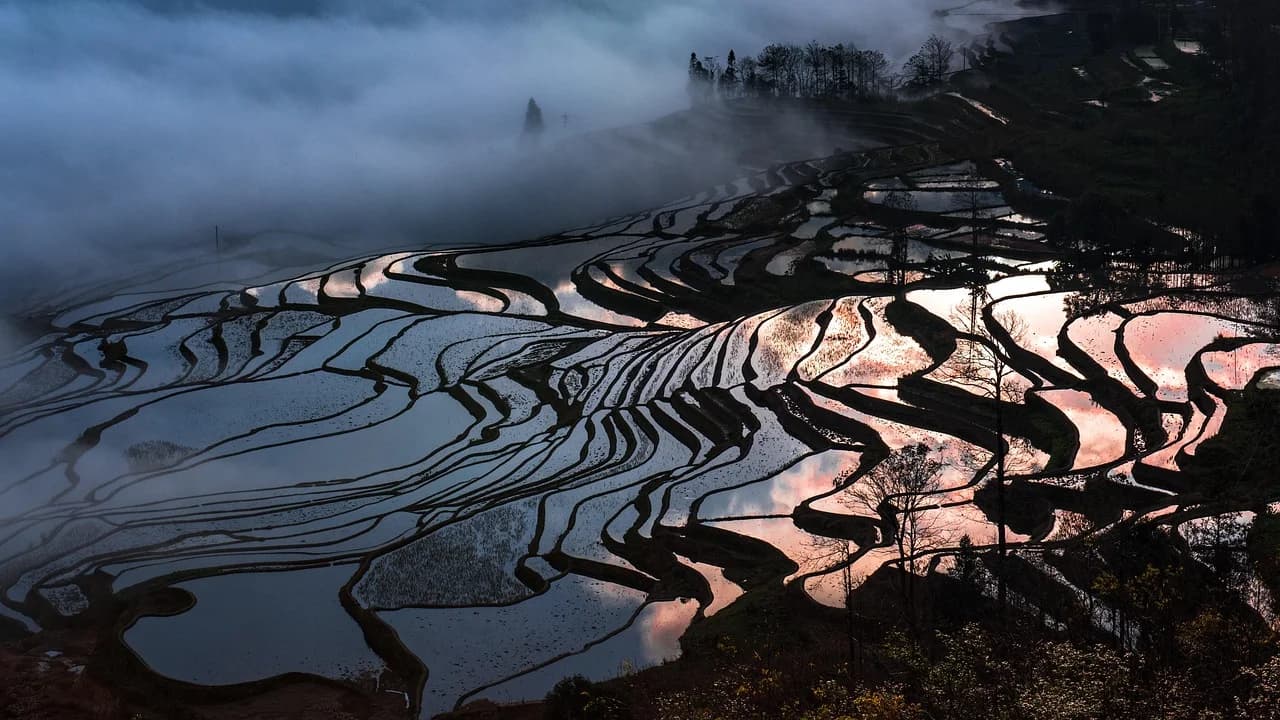
You stand at the viewpoint as the sun rises, and the scene before you defies belief. Thousands of water-filled terraces cascade down mountainsides, each one a perfect mirror reflecting the pink and gold of dawn. The terraces flow like liquid staircases from misty peaks at 2,000 meters down to river valleys at 700 meters—an unbroken sculpture of water and earth that has been shaped by human hands for over 1,300 years.
The Yuanyang Rice Terraces (元阳梯田) are not just a landscape—they're a living agricultural system, a UNESCO World Heritage Site, and one of the most visually spectacular places on Earth. Carved into the steep Ailao Mountains by the Hani people and neighboring ethnic groups, these terraces cover 16,603 hectares across the valleys and slopes of southern Yunnan. Unlike rice terraces elsewhere that are green with crops most of the year, Yuanyang's terraces are flooded from November to April, transforming every field into a mirror that reflects sky, clouds, and sunrise colors.
This is China's ultimate landscape photography destination—and also one of its most remote, rewarding, and least-visited. Getting here takes effort. But when you watch 3,000 terraces ignite with sunrise color, you'll understand why photographers and travelers make the journey.
Quick Facts at a Glance
| Item | Details |
|---|---|
| Location | Yuanyang County, Honghe Prefecture, southern Yunnan |
| UNESCO Status | World Heritage Site since 2013 |
| Total Area | 16,603 hectares of terraced rice paddies |
| Elevation Range | 700m to 2,000m |
| Age | Over 1,300 years |
| Best Time | November–April (terraces flooded, reflective) |
| Entry Fee | ¥100 (7-day pass for all main viewpoints) |
Understanding Yuanyang: The Terraces and Their Creators
Yuanyang's terraces are the product of 1,300 years of continuous cultivation by the Hani and other ethnic minorities. Understanding this context adds profound meaning to the visual spectacle.
The Hani People
The Hani (哈尼族) are one of China's 56 recognized ethnic minorities, with about 1.6 million people concentrated in southern Yunnan. For over a millennium, they've shaped these mountains into one of humanity's great agricultural achievements.
Their system works like this:
- Forests on the mountaintops capture rain and mist
- Water flows down through thousands of terraces, each field irrigated by the one above
- Villages sit mid-slope, surrounded by their fields
- Rivers at the valley bottom receive the runoff
This vertical ecosystem—forest, village, terrace, river—is a masterpiece of sustainable agriculture that has operated continuously for 1,300+ years.
The Terracing Feat
Scale: 16,603 hectares of terraces covering mountain slopes from 700m to 2,000m Density: Some hillsides have over 3,000 terraces Precision: Each terrace is level to within centimeters, allowing even water distribution Duration: Built and maintained over 1,300 years without machinery
The engineering is remarkable: water flows from terrace to terrace via small gaps in the earthen walls, irrigating all fields from a single water source at the top. The system requires constant maintenance but no pumps or modern irrigation.
The Seasonal Cycle
| Season | Conditions | Photography |
|---|---|---|
| Nov–Feb | Flooded terraces, winter light | Best—mirrors reflect sunrise/sunset |
| Mar–Apr | Flooded, rice planting begins | Excellent—still reflective, activity |
| May–Jun | Rice growing, green fields | Good—lush green, no reflections |
| Jul–Aug | Rice maturing, golden tint | Good—golden before harvest |
| Sep–Oct | Harvest, terraces dry | Least photogenic—brown and dry |
The magic window: November to April, when terraces are flooded and every field becomes a mirror.
The Main Viewpoints: Where to See the Terraces
Yuanyang's terraces are spread across multiple mountains and valleys. Four main scenic areas each offer different perspectives.
Bada Scenic Area (坝达景区) — Most Terraces
The most expansive view: 3,700+ terraces cascading down a single mountainside, stretching to the horizon. This is where you go for the "endless terraces" shot.
| Detail | Info |
|---|---|
| Best time | Sunset (terraces face west) |
| Terraces visible | 3,700+ |
| Altitude | 1,800m |
| Character | Vast, sweeping, epic scale |
Photography tip: The viewpoint platform can be crowded at sunset. Arrive early to claim position, or walk to alternative viewpoints along the road.
Duoyishu Scenic Area (多依树景区) — Best Sunrise
The most famous sunrise location—and for good reason. A natural amphitheater of terraces catches the first light beautifully, with mist rising from the valleys below.
| Detail | Info |
|---|---|
| Best time | Sunrise (terraces face east) |
| Character | Dramatic sunrise light, mist, color |
| Crowds | High at sunrise—arrive before dawn |
The shot: Arrive in darkness, watch the terraces emerge from mist as the sky turns pink, then gold, then the sun crests the mountain and ignites every flooded field. Bring a tripod.
Laohuzui Scenic Area (老虎嘴景区) — Most Dramatic
"Tiger's Mouth" is named for the cliff face that drops away beneath the viewpoint. The terraces here spiral in dramatic curves, creating some of the most striking compositions.
| Detail | Info |
|---|---|
| Best time | Afternoon to sunset |
| Character | Dramatic curves, steep slopes |
| Note | Partially damaged in 2017 landslide, now reopened |
Photography tip: The spiral patterns work best with side lighting—afternoon light raking across the curves.
Qingkou Scenic Area (箐口景区) — Cultural Immersion
Less about viewpoints, more about experiencing Hani village life. A traditional village with mushroom-shaped houses, surrounded by accessible terraces you can walk through.
| Detail | Info |
|---|---|
| Best for | Walking among terraces, village culture |
| Character | Intimate, accessible, cultural |
| Time needed | 2–3 hours |
Experience: Walk the paths between terraces, visit Hani homes (with invitation), photograph daily life. Less crowded than the main viewpoints.
Planning Your Visit: Practical Essentials
Yuanyang is remote—planning ahead makes the difference between a frustrating trip and an unforgettable one.
Getting to Yuanyang
From Kunming:
- Bus: 6–7 hours from Kunming South Bus Station to Yuanyang New Town (南沙), then 1 hour more to Old Town (新街)
- Flight + Bus: Fly to Mengzi or Jianshui, then bus 3–4 hours
From other Yunnan destinations:
- Jianshui: 3–4 hours by bus (good combination—Jianshui has ancient architecture)
- Hekou (Vietnam border): 4 hours by bus
Where to Stay
Xinjie (新街) — The Old Town: The practical base for terraces. Small town on the mountainside with guesthouses, restaurants, and easy access to viewpoints.
| Type | Price | Notes |
|---|---|---|
| Basic guesthouse | ¥80–150 | Simple rooms, terrace views common |
| Mid-range hotel | ¥200–400 | Better facilities, fewer terrace views |
| Boutique guesthouse | ¥400–800 | Best views, atmospheric |
Duoyishu area: Stay right at the sunrise viewpoint—walk out your door in darkness, photograph, return for breakfast. A few guesthouses cater to photographers.
Getting Around
The viewpoints are spread across the mountains. You'll need transport:
- Taxi/driver: Best option. Hire a driver for half-day/full-day (¥200–400)
- Scooter rental: ¥50–80/day if you're comfortable on mountain roads
- Minibuses: Infrequent local buses connect viewpoints, not reliable
Distances from Xinjie:
- Bada: 15km (20 min)
- Duoyishu: 25km (35 min)
- Laohuzui: 30km (40 min)
Entry Fee
A single ¥100 ticket covers all four main scenic areas for 7 days. Buy at any entrance. The ticket includes:
- Bada
- Duoyishu
- Laohuzui
- Qingkou
Photography Guide: Capturing the Terraces
Yuanyang is a pilgrimage site for photographers. Here's how to get the shots.
The Essential Shots
1. Duoyishu Sunrise: Arrive before dawn, tripod mandatory. Watch the mist clear as the sky transitions through blue, pink, orange, gold. The flooded terraces mirror every color.
2. Bada Sunset: The vast expanse of 3,700 terraces glowing in warm light. Golden hour here is spectacular.
3. Tiger's Mouth Curves: The spiral terraces at Laohuzui catch afternoon light beautifully.
4. Intimate Details: Beyond the grand vistas: farmers working, buffalo in fields, reflections in single terraces.
Technical Tips
Gear:
- Tripod (essential for sunrise/sunset)
- Wide angle lens (24–35mm for sweeping landscapes)
- Telephoto lens (70–200mm for compressing patterns)
- Polarizing filter (reduces glare on water, enhances sky)
- Graduated ND filter (balances bright sky with darker terraces)
Settings:
- Shoot RAW for maximum flexibility
- Low ISO (100–400) when possible
- Small aperture (f/8–f/11) for sharpness across the scene
- Bracket exposures—the dynamic range is challenging
Timing:
- Sunrise: Arrive 45–60 minutes before dawn
- Sunset: Arrive 1 hour before for setup
- Blue hour: Stay after sunset for reflected sky colors
Weather Considerations
| Condition | Quality | Notes |
|---|---|---|
| Clear sunrise | Excellent | Best colors and reflections |
| Misty/foggy | Excellent | Dramatic, mysterious—peak Yuanyang |
| Overcast | Good | Soft light, muted colors |
| Rainy | Poor | Skip—no reflections, slippery conditions |
| Clouds parting | Excellent | Dramatic light rays through terraces |
Mist is your friend. Foggy mornings that gradually clear create the most dramatic images—terraces emerging from clouds is the classic Yuanyang shot.
Best Time to Visit: Seasonal Guide
Timing is everything at Yuanyang. The terraces transform dramatically through the year. For a country-wide seasonal overview, see our guide to the best time to visit China.
The Flooded Season (November–April) ⭐⭐⭐⭐⭐
This is when to come. Every terrace is flooded for the winter fallow period, creating thousands of mirrors that reflect sky, clouds, and sunrise colors.
November–January: Peak conditions. Cold mornings increase mist probability. Fewer tourists than spring.
February–March: Chinese New Year brings domestic tourists. Still excellent conditions. Planting begins late in the season.
April: Rice seedlings planted. Terraces still partially reflective but increasingly green. Transition period.
The Growing Season (May–October) ⭐⭐⭐
Terraces are filled with rice plants rather than water—beautiful but different:
- May–June: Bright green fields, lush vegetation
- July–August: Rice matures, hints of gold
- September–October: Harvest season, terraces go brown—least photogenic
If you can only visit in summer, you'll see beautiful green landscapes—just not the famous mirror reflections.
Weather Expectations
| Month | Temperature | Conditions |
|---|---|---|
| Nov–Feb | 5–15°C | Cold mornings, mist common |
| Mar–Apr | 10–20°C | Warming, spring weather |
| May–Jun | 15–25°C | Rainy season beginning |
| Jul–Aug | 18–28°C | Rainy, humid |
| Sep–Oct | 12–22°C | Drying out, harvest |
Bring layers: Mornings can be cold (especially waiting for sunrise), days warm up considerably.
Experiencing Hani Culture
Beyond the landscapes, Yuanyang offers a window into the living culture that created the terraces.
Visiting Hani Villages
Several traditional villages welcome visitors:
Qingkou Village (箐口村): The most accessible, within the Qingkou Scenic Area. Traditional mushroom-shaped houses (thatched roofs on stone/timber bases), small museum, village life.
Shengcun and Other Villages: Ask locally about visiting smaller villages. Bring a camera, but ask permission before photographing people.
Hani Market Days
Local markets rotate between villages on a traditional calendar. Your guesthouse can advise on market days during your visit. Markets feature:
- Fresh produce
- Traditional handicrafts
- Livestock trading
- Local snacks and food
This is where you see Hani people in traditional dress, especially older women.
Traditional Architecture
The classic Hani house has three levels:
- Ground floor: Livestock, storage
- Middle floor: Living space, kitchen
- Top floor: Grain storage, sleeping
The distinctive "mushroom" profile comes from thatched or tiled roofs that overhang the walls. Modern materials are replacing traditional construction, but some villages maintain the old style.
Local Food
| Dish | Description |
|---|---|
| Field snails (田螺) | Collected from flooded terraces, stir-fried |
| Bamboo shoots | Fresh in season, various preparations |
| Hani sausage | Smoked pork sausage |
| Sticky rice | Colored with natural plant dyes for festivals |
| Rice wine | Locally brewed, offered as hospitality |
Practical Tips
Yuanyang's remoteness means some logistical challenges. Here's how to handle them.
What to Bring
- Warm layers: Cold mornings, especially for sunrise
- Rain jacket: Weather changes quickly in the mountains
- Good walking shoes: Paths between terraces can be muddy
- Headlamp/flashlight: For pre-dawn navigation
- Tripod: Essential for photography
- Cash: Limited ATMs, many places cash-only
- Power bank: Camera batteries drain in cold
Language
English is very limited in Yuanyang. Have translation apps ready, learn basic Chinese phrases, or hire a guide/driver who speaks some English.
Connectivity
- Mobile signal is reasonable in towns, spotty at viewpoints
- WiFi at most guesthouses
- VPN needed for foreign websites
Health Considerations
- Altitude: 1,800m is manageable but be aware
- Mountain roads: Winding roads can cause motion sickness
- Water: Drink bottled water
- Sun: High altitude = strong UV
Combining with Other Destinations
Yuanyang is off the main Yunnan tourist trail. Here's how to work it into a broader itinerary.
Natural Combinations
Jianshui Ancient Town (建水): 3 hours from Yuanyang. Excellent Ming/Qing architecture, famous tofu, historic bridges. Makes a great overnight stop en route.
Kunming: 6–7 hours by bus. Most visitors transit through Kunming. See Stone Forest if you have time.
Vietnam (Hekou Border): 4 hours from Yuanyang. Continue into Vietnam at Lao Cai if you have the visa.
Suggested Itineraries
3 Days Yuanyang:
- Day 1: Arrive afternoon, Bada sunset
- Day 2: Duoyishu sunrise, rest, Laohuzui afternoon
- Day 3: Village visit, departure
5 Days Yunnan Southern Route:
- Day 1: Kunming to Jianshui (train/bus)
- Day 2: Jianshui exploration
- Day 3: Jianshui to Yuanyang
- Day 4: Yuanyang terraces
- Day 5: Return to Kunming or continue
Photography Intensive (4–5 Days): Multiple sunrises and sunsets at different viewpoints, village visits, waiting for perfect weather.
Planning Your China Trip
- Best time to visit — Month-by-month guide to weather, crowds, and holiday periods
- How much does it cost? — Complete breakdown of daily budgets, attraction fees, and transport costs across China
- Essential tips for first-timers — Apps to download, payment setup, cultural etiquette, and common mistakes
About This Guide
This guide was written by the Gopagoda Travel team based on visits to Yuanyang during the optimal flooded season. Conditions, roads, and facilities can change—verify current details locally. Weather is unpredictable; allow flexibility for best photographic results.