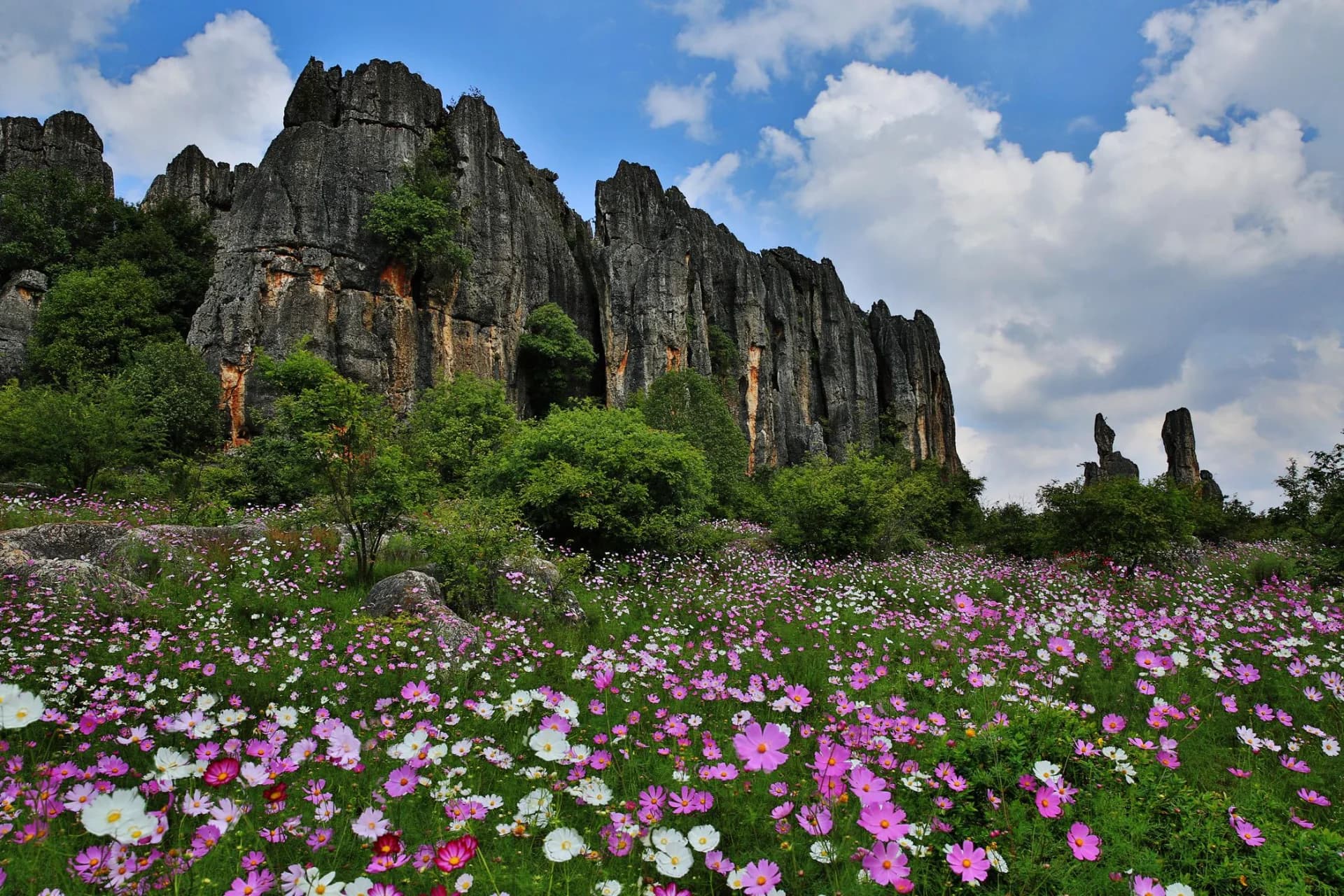

Overview
You walk between towering limestone pillars that rise 30 meters above you like a forest of stone giants frozen mid-stride. The formations are fantastical: some resemble animals, others look like mushrooms, swords, or figures from Chinese mythology. Narrow passages wind between the rocks, opening suddenly into hidden clearings. After an hour wandering these geological wonders, you realize: the name "Stone Forest" isn't metaphorical—this genuinely feels like a forest, just one made of rock.
The Stone Forest (石林, Shílín) is one of China's most famous natural landmarks and a UNESCO World Heritage Site covering 350 square kilometers of karst formations in Yunnan Province. Located just 90 kilometers from Kunming, it's the most accessible major attraction in Yunnan—perfect for a day trip from the provincial capital or a stop en route to Yunnan's northern attractions.
Formed over 270 million years when this area was an ancient seabed, the limestone formations have been carved by water and wind into a wonderland of spires, pillars, caves, and grottos. The Sani people (a branch of the Yi ethnic minority) have called this place home for generations, adding cultural depth to the geological spectacle.
Quick Facts at a Glance
| Item | Details |
|---|---|
| Location | Shilin County, 90km southeast of Kunming |
| UNESCO Status | World Heritage Site since 2007 (South China Karst) |
| Total Area | 350 square kilometers |
| Main Scenic Area | 12 square kilometers |
| Age | 270 million years |
| Entry Fee | ¥130 (includes electric shuttle) |
| Hours | 07:30–18:00 |
| Time from Kunming | 1.5 hours by car, 30 min by high-speed train |
The Stone Forest Landscape: What You'll See
The Stone Forest isn't a single formation but a collection of distinct areas, each with different character. Here's what awaits.
Major Stone Forest (大石林)
The main attraction—dense clusters of grey limestone pillars rising up to 30 meters, creating a maze of pathways and viewpoints. This is where the famous formations with evocative names are located.
Famous formations:
- Ashima Stone (阿诗玛): Named for the Sani legend heroine, this pillar resembles a young woman with a basket on her back
- Stone Forest Pavilion (石林胜景): The iconic viewpoint overlooking the sea of stone pillars
- Sword Peak Pond (剑峰池): Pillars surrounding a tranquil pool
- Lotus Peak (莲花峰): Formations resembling lotus flower petals
Time needed: 1.5–2 hours
Minor Stone Forest (小石林)
Smaller, more graceful formations with more open space between them. The pillars here are shorter and more intimate in scale, with grassy lawns for resting.
Highlights:
- More photogenic compositions (less crowded)
- Easier walking paths
- Ashima Stone is actually located here
Time needed: 45 min–1 hour
Naigu Stone Forest (乃古石林)
A separate area 10km from the main scenic area, featuring darker stone with a wilder, more primitive atmosphere. Far fewer tourists.
| Detail | Info |
|---|---|
| Entry | ¥25 (separate from main ticket) |
| Character | Darker stone, less developed, fewer crowds |
| Best for | Visitors who've seen the main forest and want more |
Zhiyun Cave (芝云洞)
An underground karst cave system with stalactites, stalagmites, and cave formations. A nice addition if you have extra time.
| Detail | Info |
|---|---|
| Entry | Included with main ticket |
| Time needed | 30–45 minutes |
| Character | Cool underground break from sun |
Planning Your Visit: Practical Essentials
Stone Forest is straightforward to visit from Kunming. Here's how to plan efficiently.
Getting There from Kunming
Option 1: High-Speed Train (Recommended)
| Detail | Info |
|---|---|
| Route | Kunming → Shilin West Station |
| Duration | 24 minutes |
| Cost | ¥34 |
| Frequency | Multiple trains daily |
| From station to park | Bus or taxi, 15 minutes |
Option 2: Tourist Bus
| Detail | Info |
|---|---|
| Route | Kunming East Bus Station → Stone Forest |
| Duration | 1.5–2 hours |
| Cost | ¥35–45 |
| Frequency | Departures throughout the day |
| Advantage | Drops you at entrance |
Option 3: Private Car/Taxi
| Detail | Info |
|---|---|
| Duration | 1.5 hours |
| Cost | ¥300–400 round trip |
| Advantage | Flexible timing, door-to-door |
Option 4: Guided Tour Many Kunming hotels offer Stone Forest day tours including transport, guide, and entrance (¥200–350). Convenient but less flexible.
Tickets and Hours
| Item | Price |
|---|---|
| Adult ticket | ¥130 |
| Student/Senior | ¥65 |
| Child under 1.2m | Free |
| Electric shuttle (within park) | Included |
| Naigu Stone Forest | ¥25 (separate) |
Hours: 07:30–18:00 (last entry 17:30)
Peak periods: Chinese national holidays (October 1–7, May 1–3), summer weekends. The park gets very crowded—arrive early or visit on weekdays.
Suggested Itinerary
Half-Day Visit (4–5 hours):
- 09:00: Arrive at Stone Forest
- 09:30–11:30: Major Stone Forest (main formations)
- 11:30–12:30: Minor Stone Forest, Ashima Stone
- 12:30–13:00: Lunch at park restaurants
- 13:00–13:30: Zhiyun Cave (optional)
- 13:30: Depart
Full-Day Visit (6–7 hours):
- Add Naigu Stone Forest (10km away, requires separate transport)
- More leisurely pace through main areas
- Time for photography and exploration
Photography Tips
Stone Forest is photogenic but challenging. Here's how to capture it well.
Best Shots
1. Stone Forest Pavilion Panorama: Climb to the pavilion viewpoint for the classic shot of limestone pillars stretching to the horizon.
2. Ashima Stone: The iconic formation—photograph in morning light for fewer people.
3. Narrow Passages: The maze-like paths between pillars create dramatic leading-line compositions.
4. Details: Textures, patterns in the rock, plants growing from crevices—intimate shots are sometimes better than grand vistas.
Technical Challenges
Contrast: Bright sky vs. dark rock creates difficult exposure situations. Use graduated filters or HDR techniques.
Crowds: The main formations are heavily visited. Arrive early (before 9 AM) or late (after 3 PM) for fewer people.
Scale: The formations are big—include people for scale, or use wide-angle lenses to emphasize height.
Best Light
- Morning: Soft light in the narrow passages, fewer crowds
- Midday: Harsh light, worst for photos, best time to visit caves
- Afternoon: Golden light on west-facing formations
- Overcast: Actually good—soft light, no harsh shadows
Sani Culture: The People of the Stone Forest
The Stone Forest isn't just geology—it's the homeland of the Sani people, whose culture adds depth to your visit.
The Sani People
The Sani are a branch of the Yi ethnic minority, numbering about 100,000 in the Shilin area. They've lived among these stones for centuries, developing a rich culture of music, embroidery, and oral traditions.
The Legend of Ashima
The most famous Sani legend—Ashima was a beautiful girl who rejected a wealthy suitor and fell in love with a shepherd named Ahei. Through various trials, Ashima was eventually transformed into the stone pillar that bears her name. The story is performed as a folk dance and musical throughout the area.
Experiencing Sani Culture
Folk performances: Several times daily in the park, Sani performers present traditional songs and dances (usually free with entry).
Sani handicrafts: Look for cross-stitch embroidery, a Sani specialty with distinctive geometric patterns.
Torch Festival (火把节): If you visit in late June (24th–26th of the lunar calendar), you'll witness the Sani's biggest celebration—bonfires, wrestling, bullfighting, and all-night dancing.
Practical Tips
Make the most of your Stone Forest visit with these practical considerations.
What to Bring
- Comfortable walking shoes: Paths are paved but involve significant walking
- Sun protection: Limited shade in open areas
- Water: Available in park but bring some
- Camera: This is a photogenic place
- Light jacket: Can be cool in shaded areas
Food Options
The park has several restaurants serving standard Chinese tourist fare (¥30–60/person). Quality is acceptable but not remarkable. Alternatively:
- Eat before/after in Shilin town
- Bring snacks for during your visit
Crowd Management
| Strategy | Details |
|---|---|
| Arrive early | Before 9 AM means fewer tour groups |
| Visit on weekdays | Weekend crowds are significantly larger |
| Avoid holidays | National Day and Labor Day are extremely crowded |
| Go to Minor Forest first | Tour groups hit Major Forest first |
| Explore side paths | Main routes are crowded; side passages are quieter |
Navigation
The park is large but well-signed. Electric shuttles run between major areas. Walking the full circuit takes 3–4 hours. Don't try to see everything—focus on the main formations and enjoy them properly.
Stone Forest as Part of a Yunnan Trip
Stone Forest fits easily into various Yunnan itineraries. Here's how to incorporate it.
As a Kunming Day Trip
The most common approach:
- Morning: Train/bus from Kunming
- 09:00–14:00: Explore Stone Forest
- Afternoon: Return to Kunming
- Evening: Explore Kunming's Green Lake or Bird & Flower Market
En Route to Northern Yunnan
Stone Forest works as a first stop when heading to Dali/Lijiang:
- Day 1: Arrive Kunming, overnight
- Day 2: Morning at Stone Forest, afternoon train to Dali
- Day 3+: Continue to Lijiang, etc.
Kunming Area Exploration
Combine Stone Forest with other Kunming-area attractions:
- Jiuxiang Caves: Spectacular karst caves 60km from Kunming (can be combined with Stone Forest in a long day)
- Dianchi Lake: Kunming's scenic lake with waterfront activities
- Western Hills: Temple complexes overlooking Dianchi Lake
Suggested Itineraries
3 Days Kunming Area:
- Day 1: Arrive Kunming, explore city (Green Lake, Bird & Flower Market)
- Day 2: Stone Forest day trip
- Day 3: Western Hills + Dianchi Lake, or Jiuxiang Caves
7 Days Yunnan Classic:
- Day 1: Kunming arrival
- Day 2: Stone Forest
- Days 3–4: Dali
- Days 5–6: Lijiang
- Day 7: Jade Dragon Snow Mountain or departure
Common Mistakes to Avoid
Don't fall into these Stone Forest visitor traps.
1. Visiting on a Holiday
Chinese national holidays turn Stone Forest into a nightmare of crowds. The narrow passages become gridlocked. Visit on a weekday if at all possible.
2. Rushing Through
Some visitors spend just 1–2 hours racing through. The Stone Forest rewards slower exploration—wander the side paths, sit and absorb the atmosphere. Plan at least 3–4 hours.
3. Only Seeing Major Stone Forest
Minor Stone Forest is more intimate and less crowded. Naigu Stone Forest (if you have time) offers a completely different experience with almost no tourists.
4. Coming in Harsh Midday Light
The stone photographs best in soft light—morning or late afternoon. If you must visit midday, use it for the caves.
5. Expecting Wilderness
Stone Forest is a heavily developed tourism site—paved paths, tourist facilities, crowds. It's impressive but not a wilderness experience. Adjust expectations accordingly.
Planning Your China Trip
- How much does it cost? — Complete breakdown of daily budgets, attraction fees, and transport costs across China
- Best time to visit — Month-by-month guide to weather, crowds, and holiday periods
- Essential tips for first-timers — Apps to download, payment setup, cultural etiquette, and common mistakes
About This Guide
This guide was written by the Gopagoda Travel team based on visits to Stone Forest and the greater Kunming area. Practical details like transport schedules and prices may change—verify current information before traveling.