
Overview
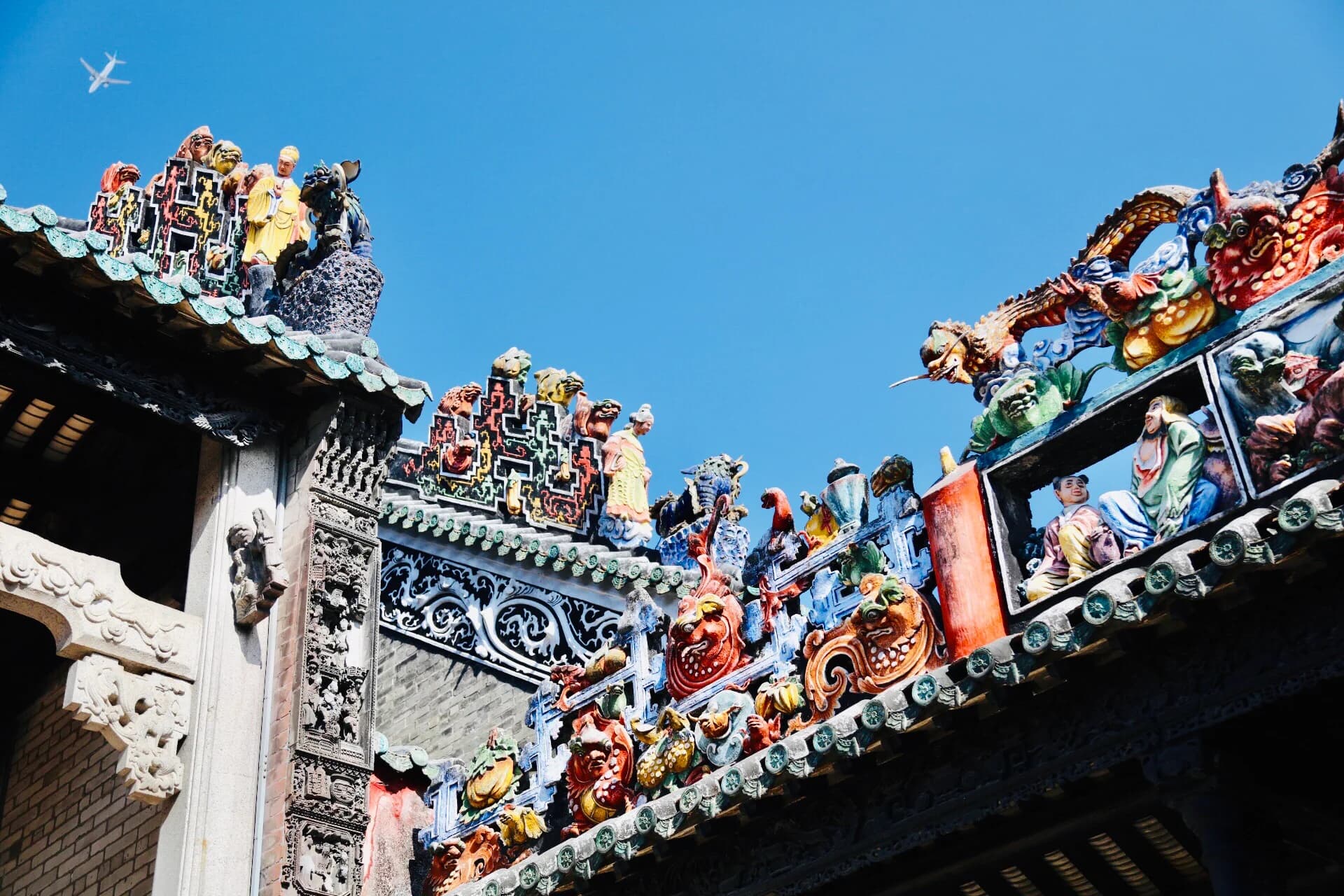
Step through the ornate doors of Chen Clan Ancestral Hall, and you're immediately surrounded by some of the most intricate decorative art in China. Every surface tells a story: dragons chase pearls across ceramic roof ridges, opera scenes unfold in impossibly detailed wood carvings, and stone lions guard doorways with expressions frozen mid-roar since 1894.
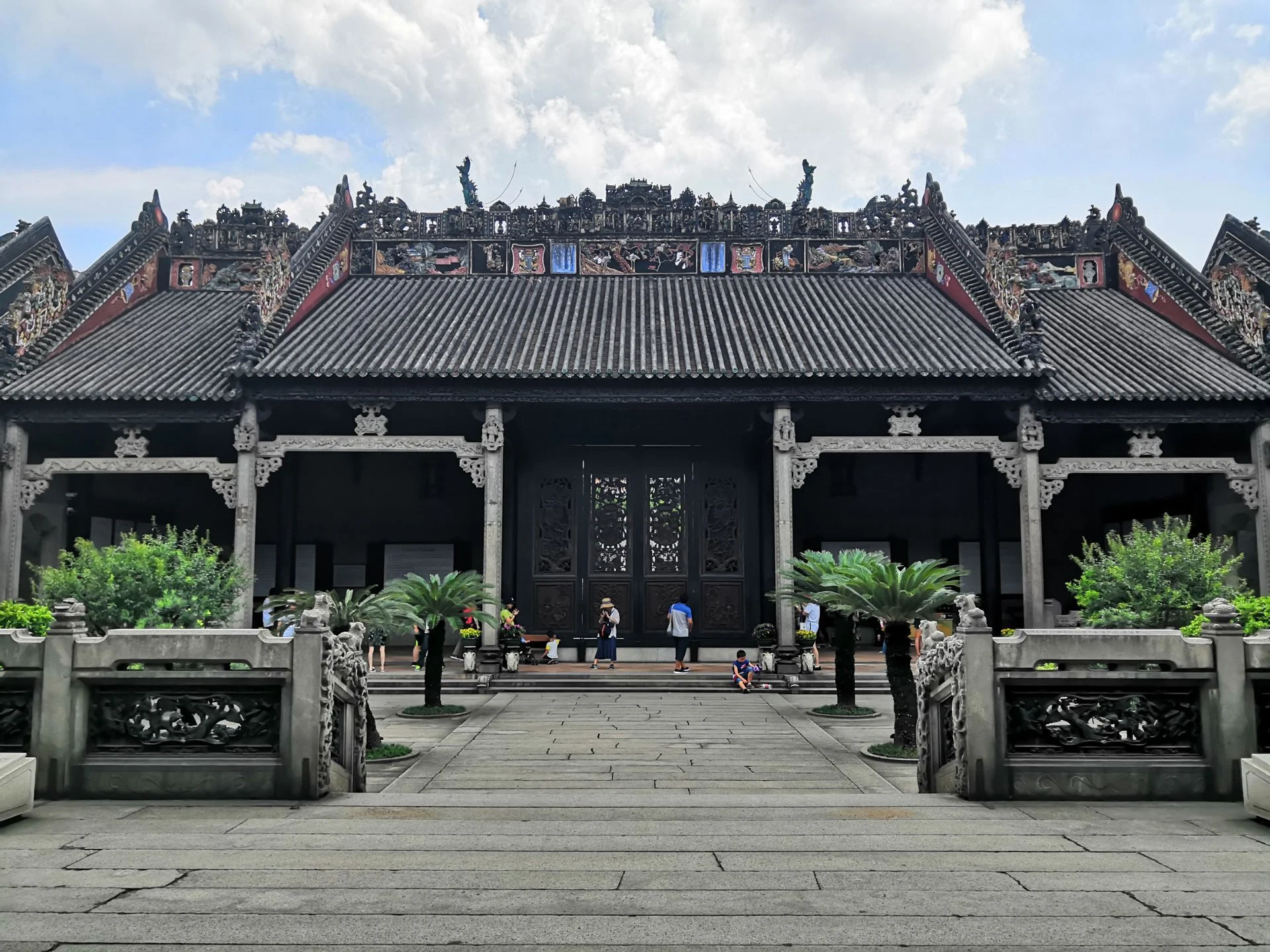
This isn't just another ancestral hall—it's a masterclass in Lingnan (嶺南) decorative arts, the distinctive style of South China that blends Chinese traditions with influences from Southeast Asia and the wider maritime world. Built by the Chen clan (one of Guangdong's most prominent families) as a combined ancestral temple, study hall, and hostel for clan members taking imperial exams, it survives today as the finest example of traditional Cantonese architecture.
At just ¥10 admission, Chen Clan Ancestral Hall offers extraordinary value. You'll need 1-2 hours to appreciate the six types of decorative arts on display: wood carving, brick carving, stone carving, ceramic sculpture, grey sculptural art, and iron casting. The complex also houses the Guangdong Folk Art Museum, with rotating exhibitions of regional crafts that have earned UNESCO recognition.
Quick Facts at a Glance
| Item | Details |
|---|---|
| Opening Hours | 09:00-17:30 (summer: 09:00-18:00) |
| Ticket Price | ¥10 adult, ¥5 student |
| Getting There | Metro Line 1, Chen Clan Ancestral Hall Station, Exit D |
| Best Time to Visit | Weekday mornings (09:00-11:00) for photography |
| Closed Days | Every Tuesday |
| Time Needed | 1-2 hours |
| ID & Booking | ID required; booking optional but recommended for holidays |
| Photography | Allowed everywhere; no flash, no tripods |
What to See: Lingnan Architectural Art at Its Finest
Chen Clan Ancestral Hall showcases six types of traditional Cantonese decorative arts, each representing centuries of craftsmanship. Here's what to look for and where to find the best examples.
Wood Carvings (木雕): Stories in Every Panel
The wood carvings at Chen Clan Ancestral Hall are considered the finest surviving examples of Cantonese woodwork. Unlike the simpler northern style, Lingnan carving favors deep relief with multiple layers—some panels have up to seven distinct planes of depth.
Where to find the best examples:
Front Hall Screen Doors (首进屏门) The most photographed feature: massive double-sided doors with carvings depicting scenes from Chinese opera, mythology, and history. Stand on both sides to see completely different scenes—the craftsmen carved different stories on each face.
Gathering Hall Partition (聚贤堂隔扇) Twenty-four carved panels illustrating "The Twenty-Four Stories of Filial Piety" (二十四孝). Each panel is a miniature narrative with incredible detail—you can count individual leaves on trees and expressions on faces.
What to look for:
- Gilded details (gold leaf was applied to highlight important elements)
- Multi-layer depth (count how many levels you can see)
- Hidden animals and symbols (craftsmen embedded lucky symbols throughout)
Brick Carvings (砖雕): Precision in Clay
Brick carving is unique to Lingnan architecture. Artisans carved intricate designs directly into grey brick using only hand tools—no molds, no templates. Each piece is one-of-a-kind.
Where to find the best examples:
Entrance Gate Walls (大门砖雕) The large panels flanking the main entrance depict "Liu Qing Presents Melons" (劉慶獻瓜) and other folk stories. Notice how the carvers achieved three-dimensional effects with flat brick.
Corridor Wall Panels Running along the eastern and western corridors, these smaller panels show landscapes, flowers, and birds. The detail is astonishing—individual feathers on birds, veins on leaves.
What to look for:
- Sharp edges (indicating skilled carving technique)
- Consistent depth across large surfaces
- Weathering patterns that reveal the age
Stone Carvings (石雕): Guardians and Symbols
The stone carvings serve both decorative and symbolic functions. Lions guard against evil spirits; drums symbolize scholarly achievement; pillars display the family's prestige.
Where to find the best examples:
Front Courtyard Lions Four pairs of stone lions in different styles—compare the expressions and poses. Traditional belief held that lions with closed mouths are female (protecting wealth inside) while open-mouthed lions are male (scaring evil away).
Stone Drum Stands (抱鼓石) These elaborate drum-shaped stones flanking doorways indicate the family's status. The more intricate the carving, the higher the rank.
Balustrade Panels The railings around the main courtyard feature carved panels showing fruits, flowers, and auspicious symbols—each with specific meanings (bats for luck, pomegranates for fertility, etc.).
Ceramic Ridge Decorations (陶塑): Drama on the Rooftop
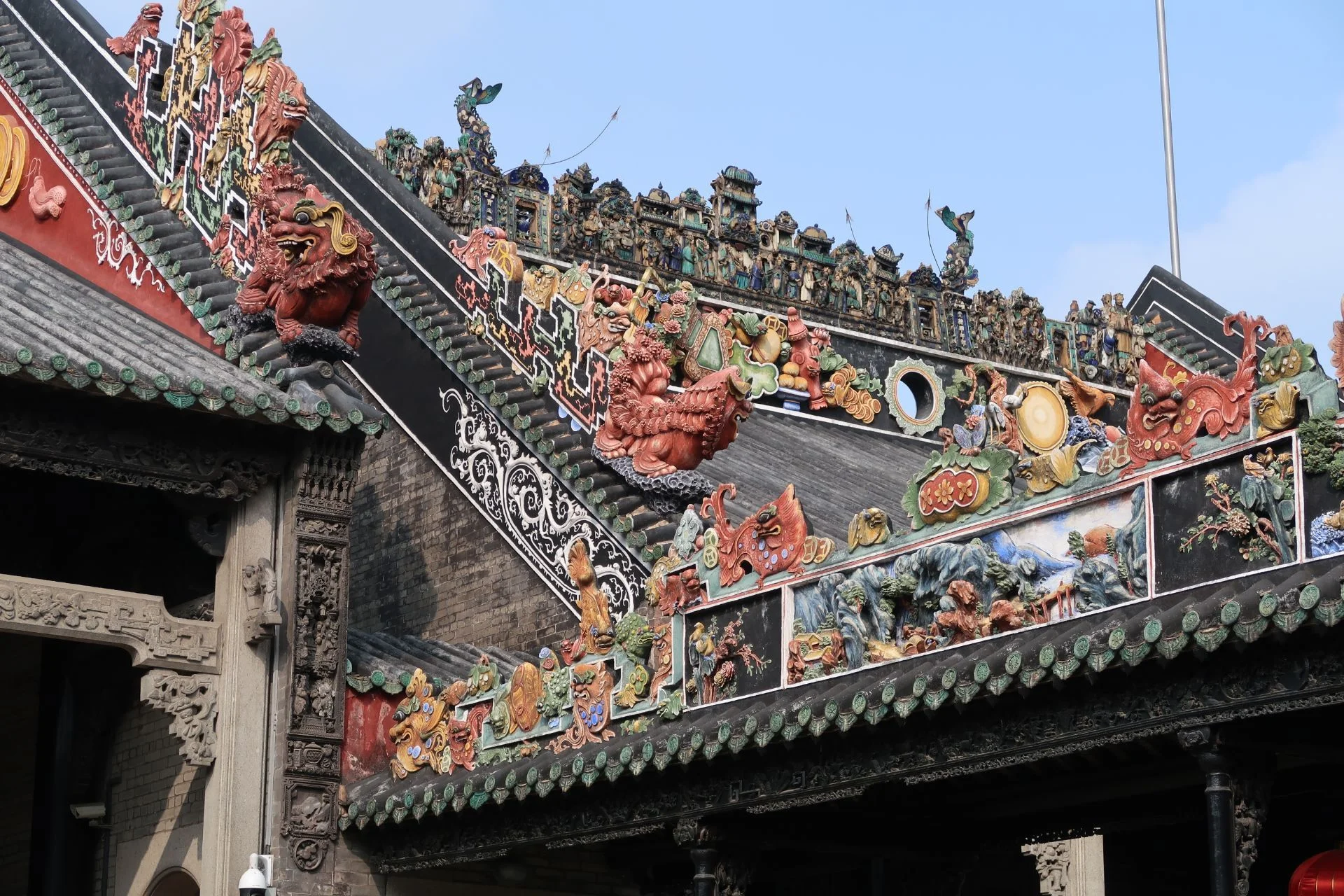
Look up, and you'll see the most spectacular feature of Lingnan architecture: ceramic ridge decorations depicting entire opera scenes, battles, and mythological stories. These colorful tableaux were made in nearby Shiwan (石灣), famous for ceramic art since the Ming Dynasty.
Where to find the best examples:
Main Hall Ridge (正脊) The central roof ridge features the most elaborate scene: multiple figures acting out a historical drama, with painted faces, flowing robes, and dynamic poses—all in ceramic.
Gable Decorations (博古脊) The sloping ridges display more intimate scenes: scholars in gardens, ladies with servants, children at play. The colors remain remarkably vivid after 130+ years.
Pro tip: Bring binoculars or use your phone's zoom to see the facial expressions and costume details—they're extraordinary.
Grey Sculptural Art (灰塑): The Forgotten Craft
Grey sculpture (灰塑) uses lime, crusite, and straw to create relief decorations. This craft is nearly extinct today, making Chen Clan Ancestral Hall's examples especially precious.
Where to find the best examples:
Wall Panel Above Doors The large panel above the main entrance depicts landscapes with mountains, water, and architecture—all in grey sculptural art, with subtle coloring that has faded gracefully over time.
Courtyard Wall Decorations Smaller panels throughout the complex show birds, flowers, and geometric patterns. The texture is different from stone or brick—softer, more painterly.
The Guangdong Folk Art Museum Collections
Since 1959, Chen Clan Ancestral Hall has housed the Guangdong Folk Art Museum (廣東民間工藝博物館). The permanent and rotating exhibitions complement the architecture beautifully.
Permanent exhibitions include:
- Cantonese embroidery (粵繡)—intricate silk needlework, some with over 1,000 stitches per square inch
- Ivory carving—delicate balls-within-balls and scenic panels (historic pieces; no new ivory)
- Foshan paper cutting—elaborate red paper designs for festivals
- Shiwan ceramics—the same tradition that created the roof decorations
Current special exhibitions: Check the museum website or entrance board for rotating shows, which change several times yearly.
Best Photo Spots
Chen Clan Ancestral Hall is one of Guangzhou's most photogenic locations. Here's where to get the best shots.
| Location | Best for | Best time |
|---|---|---|
| Front entrance (from plaza) | Classic exterior shot with full facade | Morning (09:00-10:00) for front light |
| Main hall interior | Symmetrical architecture, wood carvings | Any time (indoor) |
| Courtyard looking up | Ceramic ridge decorations against sky | Midday for blue sky contrast |
| Screen door close-ups | Wood carving details | Overcast days (no harsh shadows) |
| Stone lion portraits | Character shots | Morning or late afternoon |
| Corridor perspectives | Leading lines, traditional architecture | Weekday mornings (fewer people) |
Photography tips:
- No tripods allowed, but stabilize against pillars or railings
- Flash prohibited—use higher ISO instead
- Overcast days are actually better for carvings (no harsh shadows)
- Wide-angle lens captures architecture; macro captures carving details
- Weekday mornings have the fewest visitors in your shots
Our Recommended Routes
Chen Clan Ancestral Hall follows a traditional "three halls, three courtyards" layout. These routes help you navigate efficiently based on your available time.
Route 1 — The 1-Hour Highlights
| For | Time-limited visitors, architecture overview |
| Best time | Any time during opening hours |
| Focus | Major decorative highlights |
- Entrance plaza (5 min) — Admire the facade, photograph the roofline
- Front hall (10 min) — Double-sided screen doors (the star attraction)
- First courtyard (5 min) — Stone lions, balustrades, ceramic ridges above
- Gathering Hall (聚贤堂) (15 min) — The largest and most ornate hall
- One side corridor (10 min) — Brick carvings along the walls
- Rear hall (10 min) — Ancestral altar, quieter atmosphere
- Exit via gift shop (5 min) — Folk art souvenirs
This route gives you: The essential architectural highlights and main decorative arts.
Route 2 — The 2-Hour Complete Tour
| For | Art and architecture enthusiasts, photographers |
| Best time | Morning (fewer crowds) |
| Focus | All six decorative arts + museum exhibitions |
- Entrance plaza (5 min) — Full facade photos
- Front hall (15 min) — Screen doors from both sides
- Eastern corridor (15 min) — Brick carvings, grey sculptures
- Eastern side halls (15 min) — Museum exhibitions (embroidery, ivory)
- Gathering Hall (20 min) — Main hall, 24 Filial Piety panels
- Western corridor (15 min) — More brick carvings, compare with east
- Western side halls (15 min) — Museum exhibitions (ceramics, paper cutting)
- Rear hall (10 min) — Ancestral altar, quietest photography spot
- Roofline viewing (10 min) — Find angles to photograph ceramic ridges
This route gives you: Complete appreciation of all decorative arts plus museum collections.
How to Choose Your Route
| Your Situation | Recommended | Why |
|---|---|---|
| First visit, limited time | Route 1 | Hits all the major highlights |
| Art/architecture enthusiast | Route 2 | Complete coverage, museum included |
| Photography focused | Route 2 + extra time | Need time for compositions, lighting |
| Visiting with kids | Route 1 | Kids may lose interest after 1 hour |
| Combining with Xiguan walking | Route 1 | Save time for neighborhood exploration |
Planning a trip to China?
Our travel experts can help you create a personalized itinerary based on your interests and budget.
Getting There & Practical Info
Chen Clan Ancestral Hall is one of the most accessible attractions in Guangzhou—the metro station is literally named after it.
How to Get There
Metro (Recommended)
| Line | Station | Exit | Notes |
|---|---|---|---|
| Line 1 | Chen Clan Ancestral Hall (陈家祠) | D | 50 meters to entrance |
Exit D puts you directly in front of the entrance plaza. You cannot miss it.
From Key Locations:
- Guangzhou East Railway Station: Line 1 direct, 30 min, ¥5
- Canton Tower: Line 3 to Tiyu Xilu, transfer Line 1, 25 min, ¥4
- Beijing Road: Line 1 from Gongyuanqian, 10 min, ¥2
By Taxi/Didi
Tell driver: "陈家祠" (Chén Jiā Cí)
- From Tianhe: ¥25-35, 20-30 min (traffic dependent)
- Tip: Traffic on Zhongshan Road can be heavy; metro is often faster
Ticket Prices & Policies
| Category | Price | Notes |
|---|---|---|
| Adult | ¥10 | Standard admission |
| Student | ¥5 | Valid student ID required |
| Senior 60+ | ¥5 | Valid ID required |
| Child under 1.2m | Free | Must be accompanied |
| Disabled | Free | With valid certificate |
How to buy:
- On-site: Ticket windows accept cash and mobile payment
- Online: WeChat Mini Program "广东民间工艺博物馆" (optional, no discount)
No booking required for regular visits. During major holidays (National Day, Chinese New Year), booking through the official WeChat is recommended to guarantee entry.
Local Expert Tips
Timing:
- Best time: Weekday mornings (09:00-11:00)—fewer tour groups, better photos
- Avoid: Weekend afternoons and any time during Golden Week (Oct 1-7)
- Tuesday closure: The hall is closed every Tuesday for maintenance
What to bring:
- Phone/camera: This is a photography destination
- Binoculars: For seeing rooftop ceramic details
- Comfortable shoes: Lots of standing and walking
- Water: No drinks sold inside
What NOT to do:
- Don't use flash photography (damages artifacts, disturbs others)
- Don't touch the carvings (oils from hands cause damage)
- Don't bring large bags (no storage facilities)
- Don't rush—the details reward slow observation
Where to Eat Nearby: Xiguan Food Paradise
Chen Clan Ancestral Hall sits in the heart of Xiguan (西关), Guangzhou's traditional district famous for authentic Cantonese food at local prices.
Quick Bites (5-10 minute walk)
Zhen Zhen Xiaoshi (珍珍小食店)
- Address: 西华路183号
- Famous for: Beef offal noodles (牛杂), wonton noodles
- Price: ¥15-30/person
- The queue tells you everything—locals swear by it
Lan Fong Yuen (兰芳园)
- Address: 西华路402号
- Famous for: Hong Kong-style milk tea, toast
- Price: ¥20-40/person
- Classic cha chaan teng (茶餐厅) experience
Sit-down Restaurants (10-15 minute walk)
Panxi Restaurant (泮溪酒家)
- Address: 龙津西路151号
- Famous for: Traditional Cantonese dim sum in garden setting
- Price: ¥80-150/person
- One of Guangzhou's most famous dim sum restaurants, historic venue
Guangzhou Restaurant (广州酒家)
- Address: 文昌南路2号 (Wenchang branch)
- Famous for: Mooncakes, dim sum, Cantonese classics
- Price: ¥80-120/person
- Institution since 1935
Street Food Area
Walk 10 minutes west toward Liwan Lake Park and you'll find the Guangzhou Food Street (美食街) with dozens of stalls selling:
- Rice rolls (肠粉)
- Steamed spare ribs
- Coconut pudding
- Sugar water desserts (糖水)
Nearby Attractions & Day Trips
Chen Clan Ancestral Hall is the perfect starting point for exploring Guangzhou's historic Xiguan district.
Walking Distance (15-30 minutes)
Liwan Lake Park (荔湾湖公园) — 15 min walk west
- Traditional Cantonese garden with pavilions and bridges
- Free admission, open early morning to late evening
- Best combo: Morning dim sum at Panxi → Liwan Lake → Chen Clan Ancestral Hall
Shamian Island (沙面岛) — 20 min walk south
- Former colonial concession with European architecture
- Tree-lined boulevards, cafes, wedding photo destination
- Different vibe from Chen Clan—East meets West
Xiguan Old Houses (西关大屋) — Throughout the area
- Traditional Cantonese townhouses with distinctive architecture
- Many now converted to shops, museums, or cafes
- Look for the "趟栊门" (sliding wooden door) and "满洲窗" (colored glass windows)
Half-Day Combo Itineraries
Xiguan Heritage Walk (4-5 hours)
- 09:00: Chen Clan Ancestral Hall (1.5 hours)
- 10:30: Walk through old Xiguan streets to Liwan Lake
- 11:30: Dim sum at Panxi Restaurant
- 13:00: Liwan Lake Park stroll
- 14:00: Walk to Shamian Island
- 15:00: Coffee and photos on Shamian
Cultural Guangzhou Day (6-7 hours)
- 09:00: Chen Clan Ancestral Hall
- 11:00: Metro to Sacred Heart Cathedral (Line 1 to Line 6)
- 12:00: Lunch on Beijing Road
- 14:00: Beijing Road pedestrian street + historical ruins display
- 16:00: Metro to Canton Tower area for evening
History & Cultural Background
Chen Clan Ancestral Hall represents the peak of Cantonese clan culture and architectural achievement in the late Qing Dynasty.
The Chen Clan: One Name, Millions of People
"Chen" (陈) is the most common surname in Guangdong Province, accounting for over 10% of the population—millions of people claiming descent from the same ancient ancestors. In late imperial China, powerful clans built ancestral halls to honor ancestors, educate youth, and provide accommodation for clan members traveling to the provincial capital.
In 1888, Chen family leaders from 72 counties across Guangdong pooled resources to build the ultimate ancestral hall. They hired the best craftsmen, sourced the finest materials, and spared no expense. Construction took six years (1888-1894), employing specialists in every decorative art.
Study Hall and Examination Hostel
The hall's official name is "Chen Clan Academy" (陈氏书院), reflecting its original dual purpose: ancestral worship and education. Young Chen clan members from rural areas could stay here while preparing for the imperial examinations in Guangzhou—China's civil service tests that determined career advancement.
The examination system ended in 1905, but the building's educational function continues: today it teaches visitors about Cantonese culture and craftsmanship.
Survival Through Turbulent Times
Unlike many ancestral halls destroyed during the Cultural Revolution (1966-1976), Chen Clan Ancestral Hall survived because it had already been converted to a museum in 1959. The government recognized its architectural and artistic value, protecting it as cultural heritage rather than targeting it as "feudal" tradition.
Today it holds multiple designations: National Key Cultural Relic Protection Unit, and one of "Guangzhou's Top 10 Tourist Attractions" consistently since the 1980s.
Planning Your China Trip
- How much does it cost? — Complete breakdown of daily budgets, attraction fees, and transport costs across China
- Best time to visit — Month-by-month guide to weather, crowds, and holiday periods
- Essential tips for first-timers — Apps to download, payment setup, cultural etiquette, and common mistakes
About the Author
Wong Mei-ling (黃美玲) is an architectural historian specializing in Lingnan traditional buildings. A Guangzhou native, she has researched Chen Clan Ancestral Hall for over 15 years and contributed to its conservation planning documentation.
Wong holds a PhD in architectural history from South China University of Technology and regularly leads specialist tours of Guangzhou's historic architecture. She describes Chen Clan Ancestral Hall as "a encyclopedia of Cantonese craftsmanship frozen in time."
Editorial Standards
This guide is based on extensive field research by the GoPagoda Travel editorial team, including multiple site visits in 2025-2026. All prices, opening hours, and practical information were verified in January 2026.
Our commitment:
- Information verified through direct experience
- Prices and hours confirmed with official sources
- Honest recommendations based on visitor value
- Regular updates as conditions change
Sources include:
- Guangdong Folk Art Museum official information
- Chen Clan Ancestral Hall conservation documentation
- Field verification by GoPagoda Travel research team (January 2026)
- Academic publications on Lingnan architecture
Last updated: January 2026